
Stories: Not Too Far From The Ocean
The End of Polio? • I Was a Long-boarder • The Draft: What's Your Problem? • Timothy Leary? • To Ski or Not to Ski • Butch and Sundance • Dogs, Dogs, Dogs! • Arrivals • It's Just a Car • Fish On! • Music Musings • Walter Mitty Redux • Clamming and Crabbing • Grandpop: Can We Talk?
Arrivals
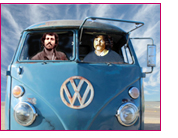
When Tommy and I decided to do one-way tickets to Europe in 1972, we had no idea what we would encounter. I was a couple of years out of UCLA with a Master's degree in graphic design and still didn't know what the hell I would do for the rest of my life.
Tommy was my friend from grammar school, and we always fantasized about traveling adventures together if life and the draft board didn't get in the way. Tommy was recently divorced and worked as a hairstylist in Hollywood. He actually turned down a job with Jay Sebring, the doomed hair stylist to the stars back in the day who was one of those murdered by the Manson family in 1969.
Tommy and I were both ready to take on the world at this point in our lives.
Amsterdam: At Last!
We arrived at Frankfurt am Main, tired and hungry, and planned to buy train tickets to Amsterdam, with an overnight in Eschersheim. I walked up to the ticket counter and asked for 2 tickets to Eschersheim, as this would be a good place to rest before traveling on to Amsterdam. The ticket agent reminded me of Peter Sellers as Dr. Strangelove in the 1964 Kubrick film, as he clearly had a disabled right arm, to say nothing about his intractable attitude at seeing two long-haired Americans.
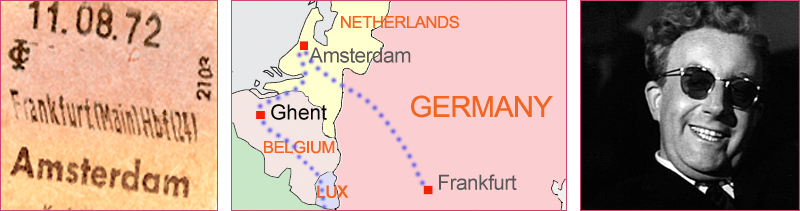
We discovered a quaint hotel in Eschersheim that had feather beds! After settling in, we bought some bread, cheese, and some delicious apples from a nearby deli. Exhausted from carrying 50 pounds of unnecessary luggage, we ended up sleeping for 15 hours. It quickly became clear that we had packed far too much. I decided to send half of my belongings back home when I arrived in Amsterdam.
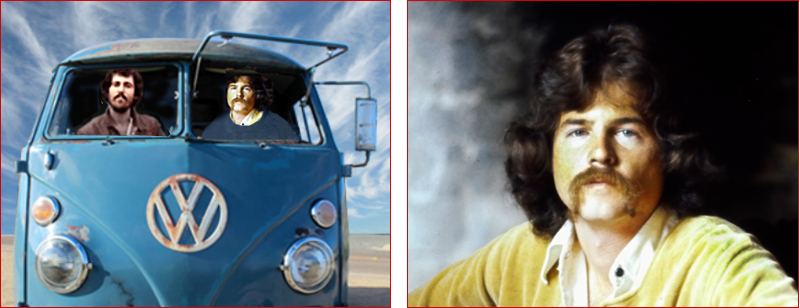
Aside from the beautiful sites of castles and vineyards along the Rhine, the train ride from Eschersheim to Amsterdam was nothing short of grueling. The conductor made an unreasonable demand, insisting we open our luggage and display our cash. I had $5,000 in American Express Travelers' Checks strapped securely to my waist in a money belt. Sure, we might have looked a bit out of the ordinary—Tommy with his scruffy, broken beard and me with a long horseshoe mustache and hair hanging down to my shoulders—what would you expect in 1972!
The conductor capitulated after he saw my money belt, go figure! We were now ready to embrace everything our journey had to offer.
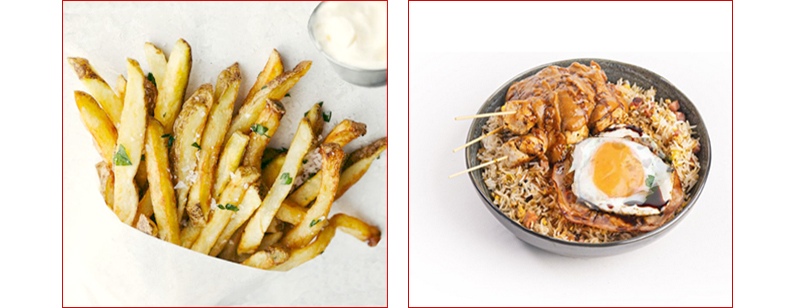
Nonetheless, we were excited to be in Amsterdam and eager to explore the culture, art, and of course, the food. Rijsttafel, those delightful small Indonesian rice dishes, was high on our list. We couldn't wait to try the Pommes Frites from street vendors—those perfect French fries served with mayonnaise—delicious. And Nasi Goreng? Absolutely!. This fried rice, loaded with succulent pieces of chicken, topped with an egg and a zesty satay sauce, was something we indulged in numerous times.
We roamed the streets of Amsterdam, sampling everything we could get our hands on, with the exception of the red-light district. We eventually landed in a cozy bed and breakfast within walking distance of the Van Gogh Museum—my top priority.

The next day, recharged after a quick breakfast, we made our way to the Van Gogh Museum. We spent the better part of the day enthralled by the incredible works I had dreamed of seeing in my art history classes.
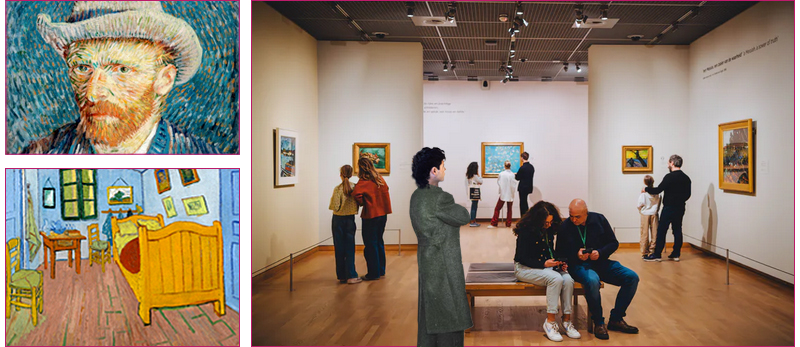
After experiencing the Van Gogh Museum, we decided it was time to continue our journey. We headed to the American Express Office in Amsterdam and discovered that travelers were selling their vehicles to get home. After a couple of hours, we found a guy selling his 1962 VW Van, a bit rusty but in fairly good condition. He wanted $300 for the van so he could purchase a plane ticket back to the States—we jumped at the opportunity and bought the van.
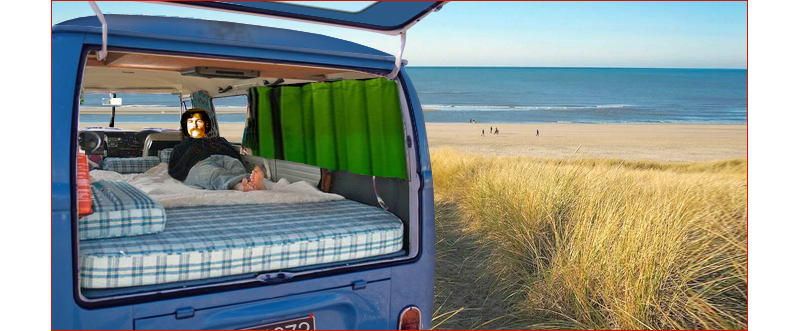
Excited, we outfitted our new van with essential amenities, including a sleeping platform, a foam mattress, a couple of sleeping bags, and a propane hotplate for cooking.
We heard there was actually surf nearby on the coast (what a concept!), so we packed up our belongings and made our way to the beach to test out our new accommodations. With everything set up, we were primed and ready for the next part of our adventure!
Belgium: The Ghent Altarpiece
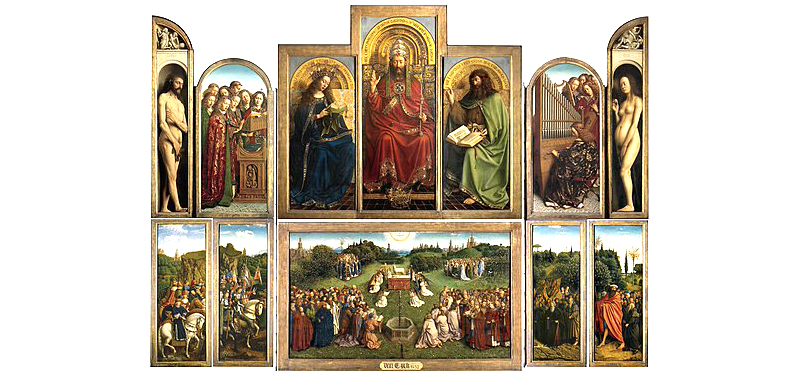
After our sojourn in the Netherlands, we made our way to Belgium as I wanted to see the Van Eyck's 15th-century Ghent Altarpiece in the medieval city of Ghent, at St. Bavo's Cathedral, which I remembered from my art history courses—the central theme revolves around the blood of Christ, believed to have saved humankind.
As luck would have it, I became sick on our way to Ghent, which might have been food poisoning from overindulging a bit in the Netherlands. My doctor did tell me that in Europe they use a different kind of fertilizer—guess! So, when we arrived in Ghent, we found a nice hotel, and after a couple of days of sweating in bed, I recovered enough to continue our journey.
The altarpiece was as spectacular as expected, and I read recently that historians now consider it the first oil painting.
We drove on to Waterloo, the site where Napoleon Bonaparte was defeated by Wellington's army in the famous 1815 battle. We set up camp in our newly acquired van. The full moon cast a bright light over a starry night, and for the first time, we slept peacefully.
The next morning, we cooked breakfast on our new propane grill and began our journey.
We were in high spirits, enjoying the beautiful drive through the Belgian countryside, until we noticed two Belgian police officers on their tricked-out BMW bikes following us. Yes, we got pulled over. Given that we were two scruffy longhairs in a dilapidated '62 VW van, it wasn't surprising—they probably thought we were up to no good. Tommy and I had made a pact not to bring any illegal drugs on our adventure since, back then, even a small amount of pot could lead to a lengthy prison sentence in a foreign country.
We pulled over to the side of the road and got out of our van as the two police officers parked their bikes and approached us. I must admit, I was more than a little annoyed. Were we speeding? No. Did we look suspicious? Yes. Okay, I get it!

Neither of us could speak Dutch, German, or French, which turned into one of our first communication challenges during our European adventure. After some back-and-forth and me tossing out a few English phrases to see if they could understand, their eye responses indicated they could. They instructed us to spread out the entire contents of our van on the side of the road.
We took out our sleeping bags, laid them on the ground, and displayed all our belongings. The officers meticulously sifted through our stuff and eventually found a prescription medication my doctor had given me for nausea in case of food poisoning. I remember trying to explain to one of the officers what those pills were for by mimicking a gagging response—somehow, they seemed to understand. Since they didn't find any illegal drugs, just my nausea pills, they let us go on our way.
We packed our belongings back into the van and started off again. I looked at Tommy, and we both smiled at each other after our unexpected encounter with the Belgian police—we were becoming seasoned travelers.
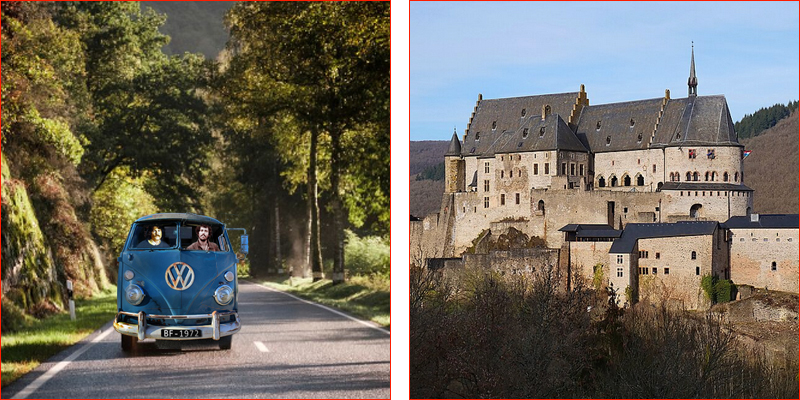
The weather was cooperating, and we made our way through the often-overlooked country of Luxembourg, enjoying spectacular views. The drive was beautiful, the views of medieval castles were reminiscent of what we experienced on the Rhine journey to Amsterdam at the start of our adventure.
We arrived late in the evening in Strasbourg. Driving at night was not one of our favorites, especially in a foreign country, so we decided to pack it in on a side street in Strasbourg and set our sites for Switzerland in the morning. Later France...

Morning found us back on the road, headed for Switzerland. Our primary focus was to drive around the north side of Lake Geneva, camp for a couple of days, visit the Rhône Glacier, then travel to Valais and take a train to Zermatt, a car-free zone, as we wanted to see the famed Matterhorn.
After a 6-hour drive, we found ourselves in Geneva, a world hub for banking and diplomacy, and not one of our interests back in the day. Exhausted, we found a quiet street to bed down for the night and started our excursion around Lake Geneva in the morning. The lake was sometimes mysteriously foggy in the morning, but still beautiful views.
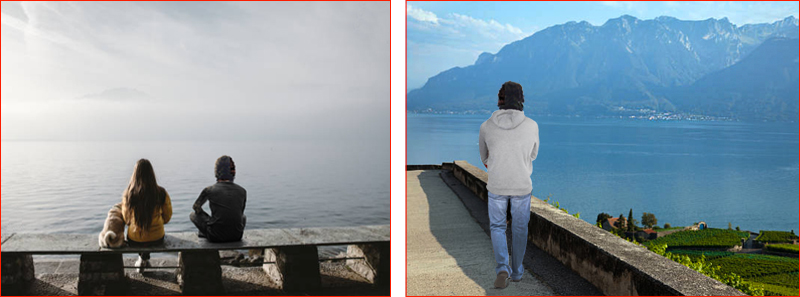
Making our way along the north side of Lake Geneva, stopping for the night, and enjoying the beautiful lakeside sites definitely met our expectations. We finally settled in at Montreux, the home of the Montreux Jazz Festival, which was not happening while we were there.
We ended up in Veytaux since we wanted to visit Château de Chillon—the famed medieval castle known for its architecture, fortress, and prison. The dungeons held many prisoners in the 16th century, including Monks, Jews, and suspected witches.

Excited, both Tommy and I were more than ready for our next stop: The Rhône Glacier, the source of the Rhône River, a short 2-hour drive from our location near Château de Chillon. As expected, the glacier was awe-inspiring. There were wooden walkways where you could hike and view this spectacular glacier, even an ice cave. I had chills photographing it, and I only hope the glacier will survive long enough for the grandkids to see. Below are a few shots I took from that day.


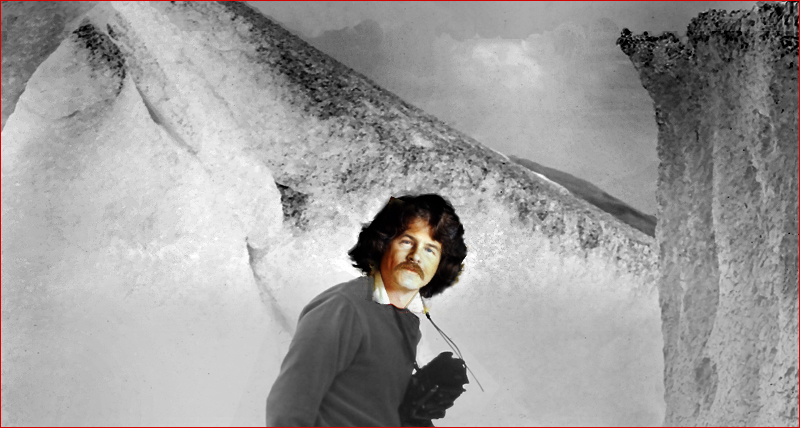
After our incredible experience at the Rhône Glacier, we set our sights on Zermatt to see the famed Matterhorn. Zermatt is a car-free city and a stopping-off point for climbers, skiers, and tourists seeking to encounter that beautiful alpine peak.
We traveled to Veytaux, parked the van, and caught a train to Zermatt—a beautiful ride.
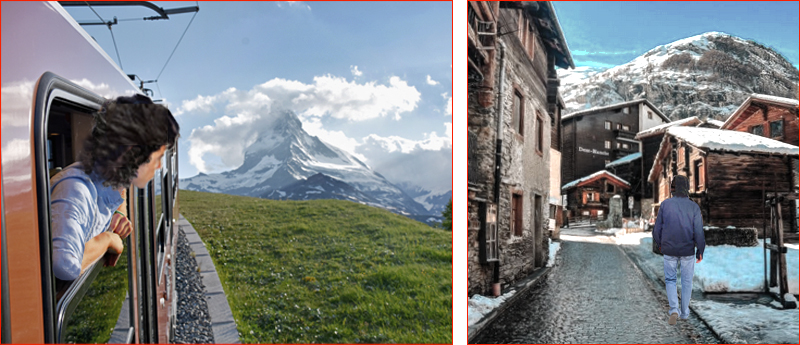
The storied village of Zermatt is situated below the iconic Matterhorn. We walked the streets mesmerized, and, being hungry, we found a restaurant and decided to partake. We ordered fondue, the delectable bread and hot cheese dish that we totally enjoyed.
As we savored the fondue, our views of the mythical Matterhorn met with our expectations but were somewhat limited, obscured by clouds. We had read about tales of evil demons and doom for climbers on the mountain.

A wonderful day in Zermatt for us, but it was getting late, so we made our way back to the train station and picked up our return train to Veytaux.
On to Munich...
Munich: Remembered

We arrived in Munich in the late afternoon, and aside from our encounter with the Belgian police, it was an uneventful drive. We navigated as close to the Olympic Stadium as possible and parked. I was intrigued by the venue architecture created by some of Germany's prominent architects—namely, the interesting tenting by Frei Otto and Günther Behnisch.
Tommy was more into getting tickets to any event, but I knew that would be nearly impossible, so I decided to just enjoy the moment. That evening, I decided to write a few letters home while Tommy walked to the Stadium in an effort to get tickets. After a few hours, he returned—he tried to get into a wrestling event, to no avail.
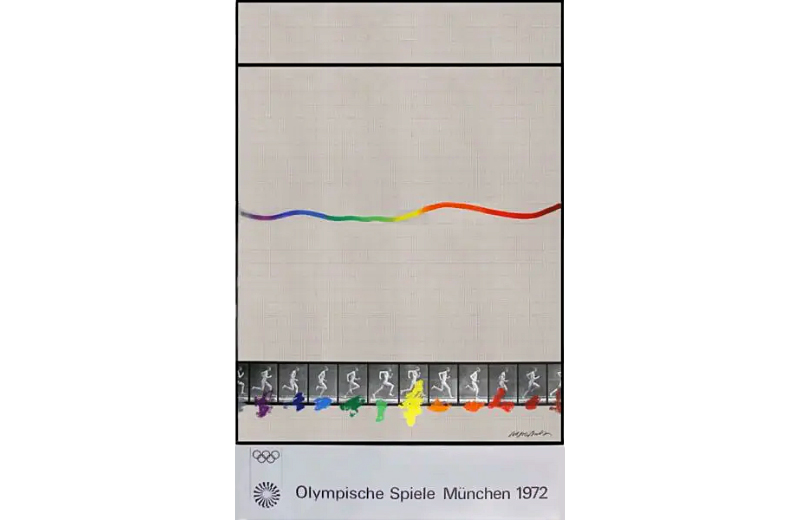
In the morning, we decided to move on. We visited a local Olympic store where I purchased a poster by Shusaku Arakawa. I loved the Robert Muybridge reference—wish I still had it!
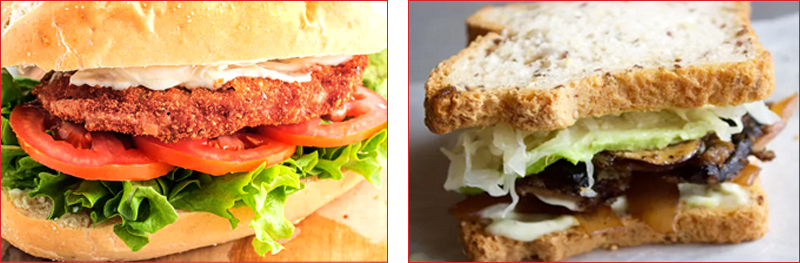
Being a bit hungry, we found a Feinkostläden (Deli) next door to the Olympic store, where I bought a delicious schnitzel sandwich. Since Tommy was a vegetarian, I believe he bought some sort of cheese/mushroom conglomeration—it did look delectable. We ate our meal in the park near the Olympic venue and decided to move on to Salzburg.
Salzburg: Some Bad News
Arrived in the beautiful city of Salzburg and decided we should rent a room and take showers since it had been some time. We found a quaint and affordable hotel with a TV, no less, and decided to stay for at least a day or two.
We packed into our room, took showers, and went down to the dining room for some well-deserved sustenance. The small TV was on and the entire room was transfixed on the news cast.
Since our language skills were lacking, we didn't understand the news cast reporting, but you had to be a bonehead to not understand the video images we were seeing.

Saddened, astounded and stupefied, we saw images from the Munich Olympics we had just left, where members of a radical Palestinian group, Black September, murdered two members of the Israeli Olympic team and took nine others hostage, who were later killed during a failed rescue attempt.
Depressed but undaunted, and forever transformed, we decided to move on to Vienna as the thought of driving seemed to quell our anxiety over what we had seen in Salzburg.
Vienna: Rain!
Rain, rain, and more rain greeted us as we arrived in Vienna. We found a campground for our stay, hoping for a break in the weather. Seeing the Lipizzaner Stallions at the Spanish Riding School was high on our list of things to do in Vienna. After spending a couple of days in the van, we started to feel a bit stir-crazy.
Finally, the rain let up, and we ventured into the city to look for tickets to a Lipizzaner Stallions performance. I don't recall the exact details, but we both agreed that the tickets seemed a bit expensive given our limited budget for what was essentially a few horses prancing around.
We wandered around the city, admiring the architecture and consulting our Michelin Guides—at that time, they were the most reliable source of information for European excursions. After having lunch and a couple of beers, we found ourselves in a ski shop, where I ended up purchasing Fisher 165 cm skis (better for my skinny legs), buckle boots (now antique), and poles. I probably spent more on ski equipment than on tickets for the dancing horses, but I felt satisfied that I made the right decision.

The Former Yugoslavia: Stunning
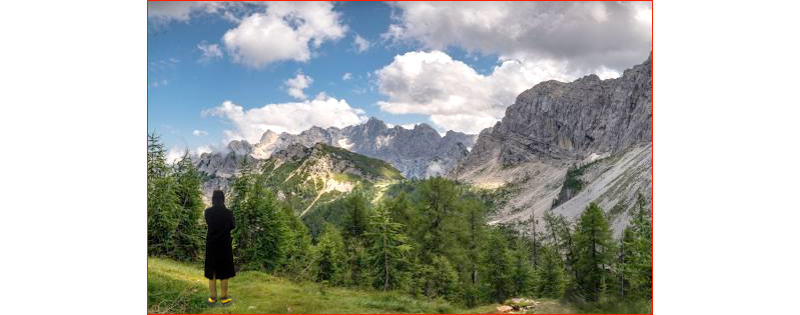
From Vienna, we made our way through the beautiful Julian Alps and found ourselves at the border with the former Yugoslavia.

We were greeted with guards carrying what looked like some sort of submachine gun, which, at first, gave us a start to say the least. They asked for our passports, and as we complied, one of them said in broken English,
"I like mustache." I was driving at the time, and he was referring to my ridiculous horseshoe mustache. I smiled and thanked him in English.
They let us pass, and we were relieved at our border crossing experience and decided to make our way down through the Julian Alps to Zagreb, as our VW van was starting to act up. We located a VW service dealership in Zagreb and spent the day waiting for our van tune-up— it was surprisingly inexpensive.
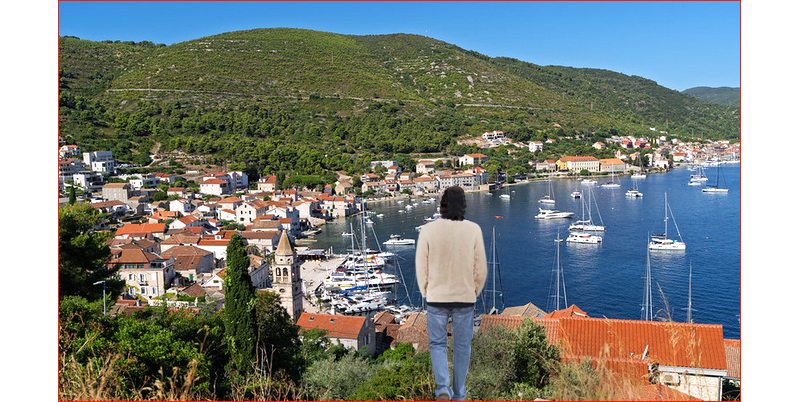
We were energized and excited as we made our way to the ancient seaside city of Pula on the Adriatic coast—now Croatia. We heard there was a spectacular Roman colosseum and beautiful beaches.
Arriving late in the afternoon, tired and hungry, we found ourselves at some sort of festival celebration on the coast where the locals were spit-roasting an entire lamb. My canines started dripping, and I convinced Tommy (the vegetarian) that we should pay the then-equivalent of $3.00 to attend.

Known as jagnjetina, lamb is a primary dish in the region for family feasts, gatherings, and celebrations. The local cooks took the lamb off the spit, chopped it up bone and all, and served portions to us attendees. Tommy opted for a salad as I satisfied my dripping canines.
The lamb was roasted to perfection. We both had a fresh salad of cabbage, lettuce, and tomatoes, and freshly sliced French fries. After a couple of Croatian beers, we were satiated and settled down in our van near the water for the night.
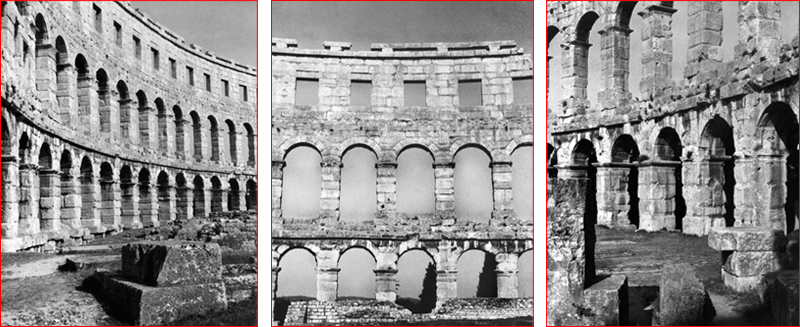
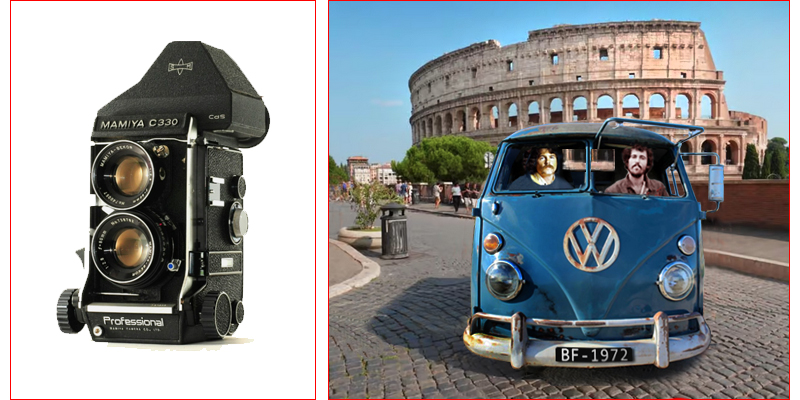
We spent the next day exploring Pula as well as the beaches and finally found ourselves at the ancient Roman amphitheater, Pula Arena, from 27BC—apparently, one of the best preserved Roman arenas from ancient times. It was an extraordinary experience for me, seeing things one can only wonder about. I shot the photographs below using my Mamiya C330 using Kodak Tri-X 400.

We hugged the coast on our journey to Split, our next destination, stopping only to enjoy the spectacular views and swim in the crystal-clear waters of the Adriatic. Split is a beautiful city rich in history. We focused on finding a reasonably priced hotel that offered a bathroom, as we were in desperate need of those amenities for more than a couple of days.
Recharged after a day exploring, we decided to move on to the historic city of Dubrovnik down the coast, renowned for its well-preserved medieval architecture. We read that wandering the back street city walls at night in this iconic city would be something to do on our adventure—excited and inspired we moved on.
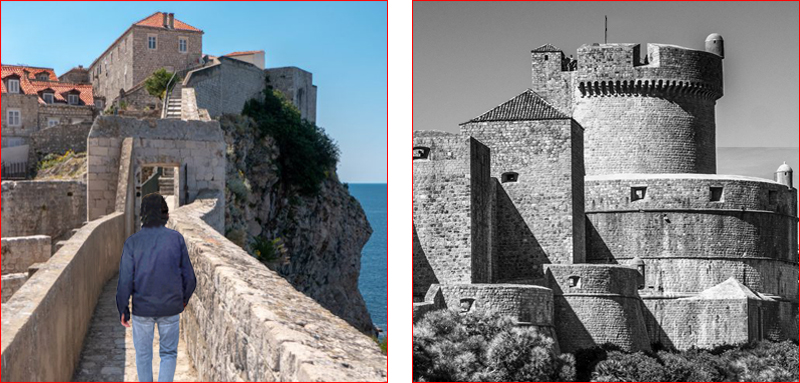
The next day, we decided to continue and avoid the Albanian coast and take a long 7+ hour drive to Skopje in Macedonia on our way to Athens, Greece, since we heard there was political unrest in Albania and didn't want to get involved. We arrived in Skopje late in the evening, settled down in the van, and discussed our next move. We both agreed to move on the following day toward Athens, as we were both excited to experience the culture of Greece.
We camped along the way on our trip through Macedonia toward Athens. It was the right decision as we encountered the wonderful local people, mainly corn farmers, as well as seeing ancient dwellings nestled in the farmland hills.
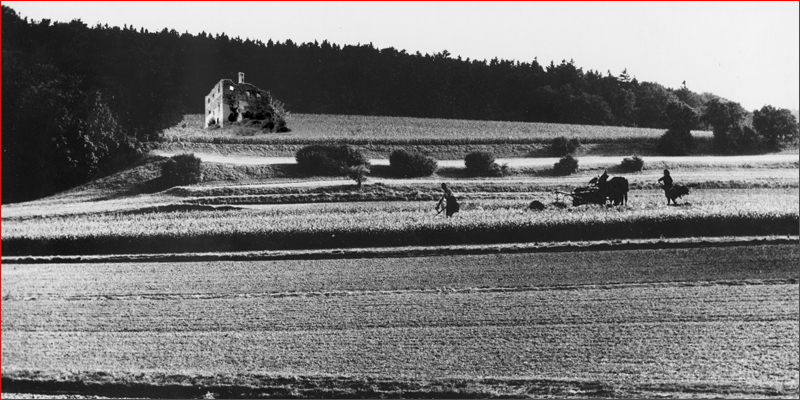
We did have an irritating experience one afternoon after driving all day. We pulled off the road and parked in a cornfield, as we thought it would be safe, and there seemed to be beautiful corn we could pick and boil up for dinner. I remember a farmer coming by in a horse-drawn cart, smiling and nodding at us—it seemed like we were accepted. I started up our propane stove and boiled some water as Tommy picked some corn. Plopping the beautiful corn in the boiling water, we were excited as we had some butter in our cooler and some salt. What could be better!
We boiled the corn, and then boiled the corn even more. I can't describe what it tasted like, even with a generous application of salt and butter—unpleasant, starchy, and chewy. We found out later that we camped in an animal feed corn field. Oh great, no wonder the farmer in the horse-drawn cart was smiling and nodding at us—we moved on the next morning.

Greece: Finally Athens
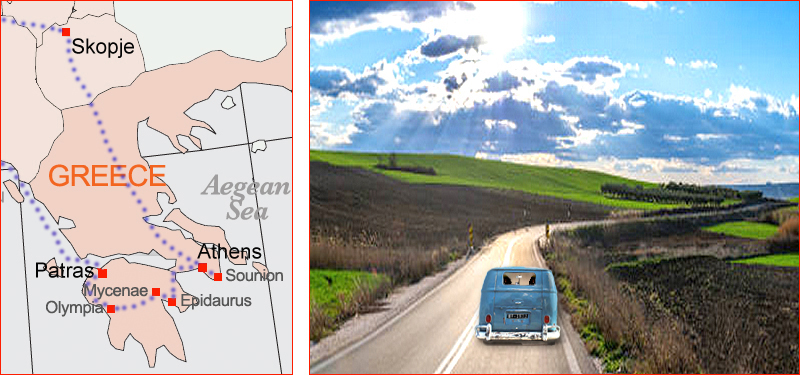
It was a beautiful yet somewhat stressful 8-hour drive from Skopje to Athens. We planned to stop and visit the Oracle of Delphi high up on the slopes of Mount Parnassus as we hoped to receive some words of wisdom about our adventure. Instead, we stopped at a local market/gas station where we filled up with gas, and I bought a bottle of Ouzo, which we sipped on our way to Athens.
We arrived in Athens and found a small basement room in the historical Plaka neighborhood. We spent a couple of days exploring and enjoying street cuisine, sampling the various forms of Gyros—pork, chicken, lamb, or beef. Of course, Tommy, being a vegetarian, opted for a traditional Greek salad.

It was time to explore some ancient art. We left our basement room in the Plaka and stopped by a local store and bought some Aunt Jemima pancake mix and a few eggs for breakfast the next morning—what a great find!
We drove through residential streets and discovered a viewpoint overlooking the Acropolis. It seemed safe, so we decided to spend the night there. The Acropolis was beautifully illuminated at night, and we were mesmerized as we drifted off to sleep.
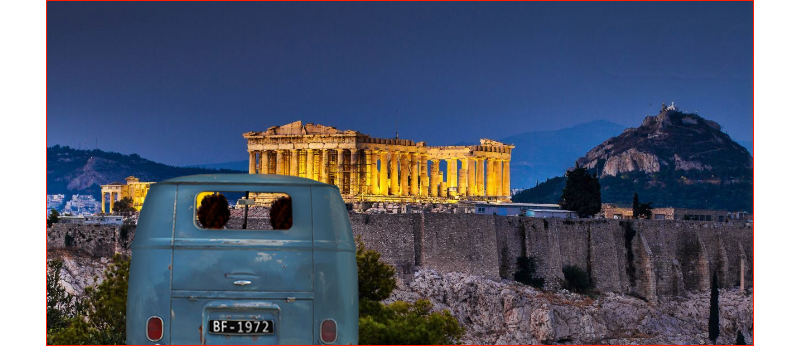
The next morning, we awoke to a beautiful day and were excited to get started on our excursion. When I opened the box of Aunt Jemima pancake mix to prepare breakfast, I found a colony of maggots residing in the box. Yikes...! Why am I not surprised. Naturally, I discarded the pancake mix and opted to fry up a couple of eggs instead. After breakfast, we set off to experience the wonders of the Acropolis.
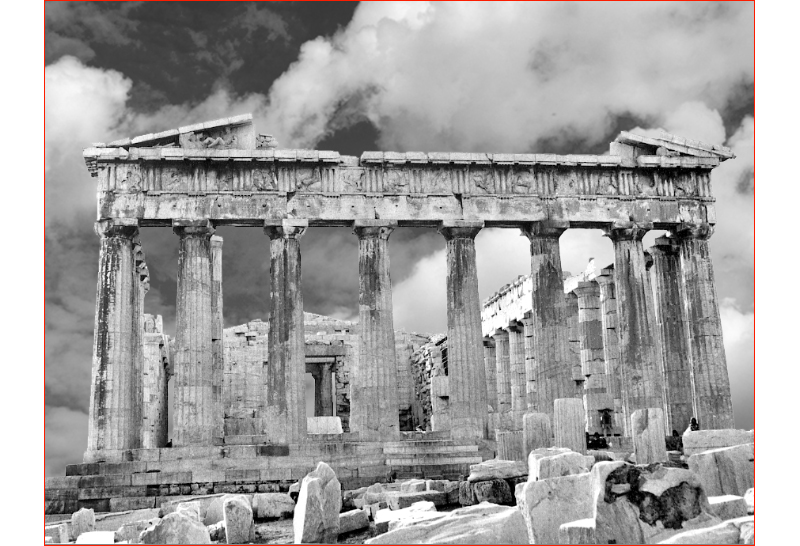
Awe-struck when finally arriving at the Acropolis, actually seeing these monuments instead of viewing them as slides in an art history class was truly inspiring. Excited, I loaded my Mamiya C330 with Tri-X 400 and decided to explore on my own, taking some images. Tommy agreed to separate for a while, and we decided to meet in a couple of hours at The Acropolis Museum.
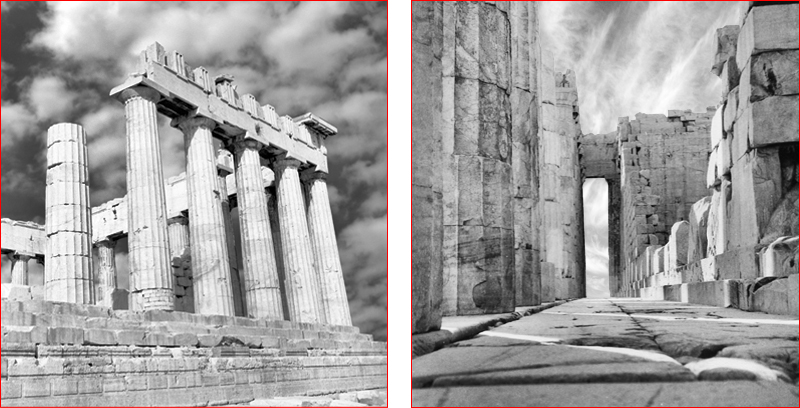
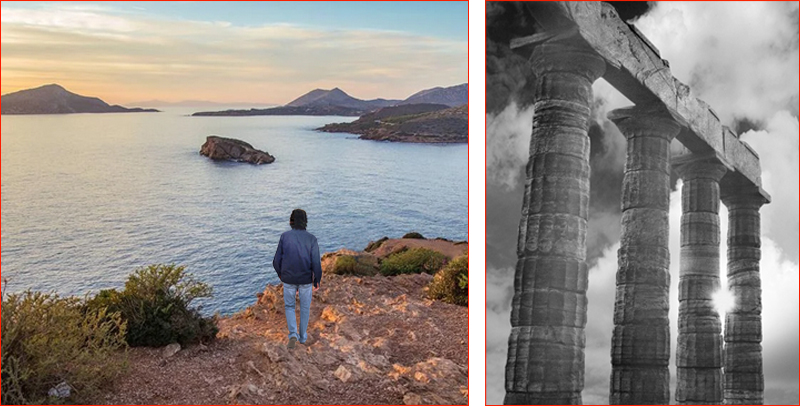
We spent the next day and a half exploring the Acropolis and then decided to drive to Cape Sounion to visit the Temple of Poseidon, a short drive from Athens nestled on the coast. We arrived in the late afternoon and decided to settle in for the night, and take in a spectacular sunset.
In the morning, we headed to the city of Epidaurus to visit the ancient Greek theater, which is considered the most perfect ancient Greek theater in terms of acoustics and aesthetics. It was a somewhat grey day, and incredibly, there were no tourists. I took a few shots and went down to the stage area, asking Tommy to stay at a high point in the theater, as I wanted to see if he could hear me speak from the stage below. From the stage, I said in a normal voice,
"I'm walkin' here!" A Dustin Hoffman quote from the film Midnight Cowboy.

Amazingly, Tommy gave me a high sign that he could hear every word from his high point in the theater. I couldn't believe it when we met up, as Tommy said it was as if we were in the same room. Apparently, they knew something in the 4th century BC—unlike today!
Tourists were starting to show up, so we moved on to our next destination, Mycenae, the home of the mythical King Agamemnon.
I was struck when we arrived and first experienced the Lion Gate of Mycenae. Interestingly, I recalled an essay question from a final exam in an art history course back in the day,
"What does the Mycenaean Lion Gate relief depict?"
I recall writing something like, "It is named for the relief sculpture of two lions that symbolized royal power for the Mycenaean civilization."
I got the question right back then, but it doesn't really matter now as just being there, years later, was enough for me.

We were both excited to continue our journey and visit the ancient site of Olympia, the birthplace of the Olympic Games, which occurred every four years from 776 BC to 393 AD.
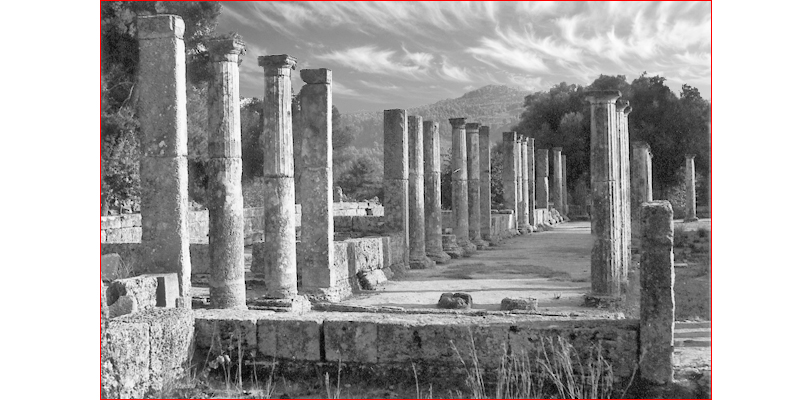
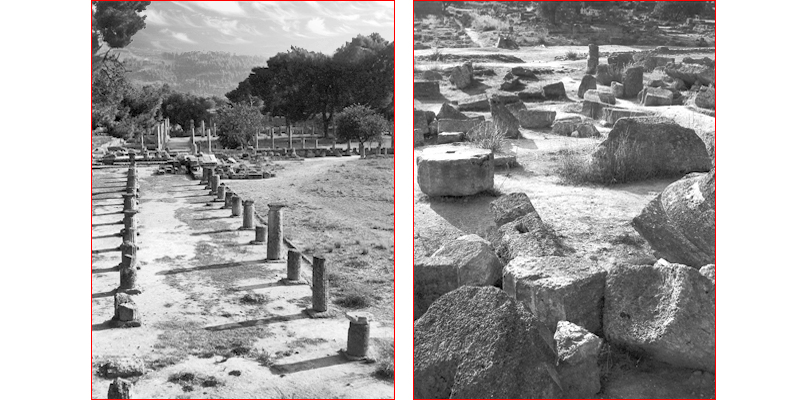
The Olympia site had many ruins that still survive and I read that the stones are limestone that were covered in stucco to mimic the appearance of marble—interesting. Below are some black and white images I shot; I remember being particularly intrigued by the cast shadows.

Leaving Olympia, we made our way to Patras, located on the northwestern coast of the Peloponnese, which is a western gateway with ferry connections to Italy. We purchased a ferry ticket to Brindisi in Italy with a stop at our last Greek location, the island of Corfu. We were especially excited to spend a couple of days on Corfu, enjoying the beaches.
On the way, Tommy got seasick, so I decided to hang out at the bar and indulge in some Ouzo for a while. I bought a T-shirt with the ship's name on it, The MV Atlanti—which I still have. In the morning, we woke up early and Tommy seemed recovered.
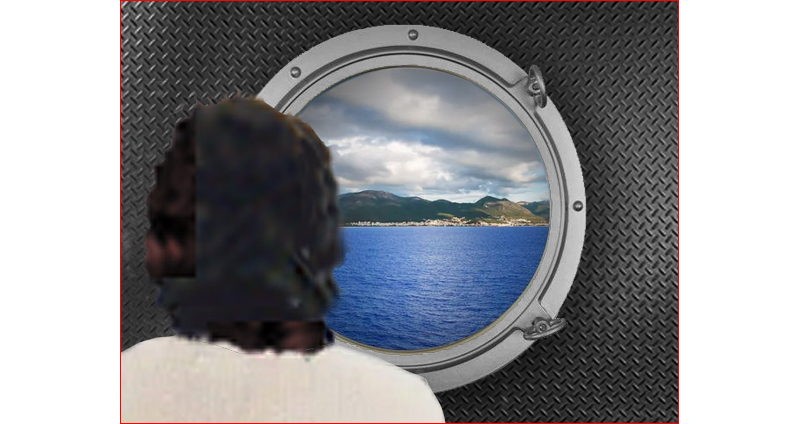
I looked through the porthole in our cabin, only to see the island of Corfu go by—Okay fine, it wouldn't be the last time we were ripped off on our adventure.
Italy: Ciao!
We arrived in Brindisi and stopped to get some gas—in those days, the currency was the Lira. We had been dealing with the money exchange issue for some time during our adventure (no computer technology in those days), so I thought 5 Lira would suffice. Little did I know that would be way less than half a gallon.
I ate some crow that day and filled the tank as the arrogant Italian station attendant smiled at me with a smug grin on his face.

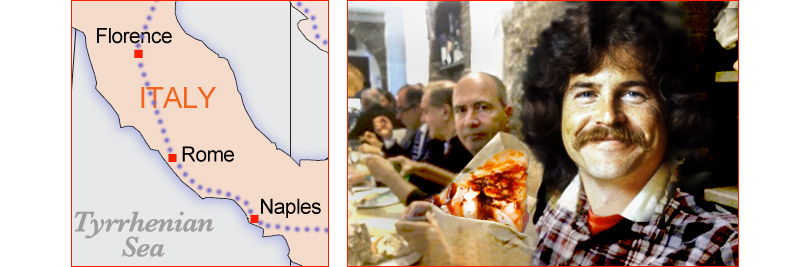
From Brindisi, we headed toward Naples, as we wanted to visit the ruins of nearby Pompeii, which was destroyed by the eruption of Mt. Vesuvius in 79 A.D.
Walking through the ruins was a chilling experience for us. On one hand, viewing the beautiful wall frescoes in the various rooms that were not completely destroyed, and on the other hand, viewing the preserved ash-covered remains of the residents.
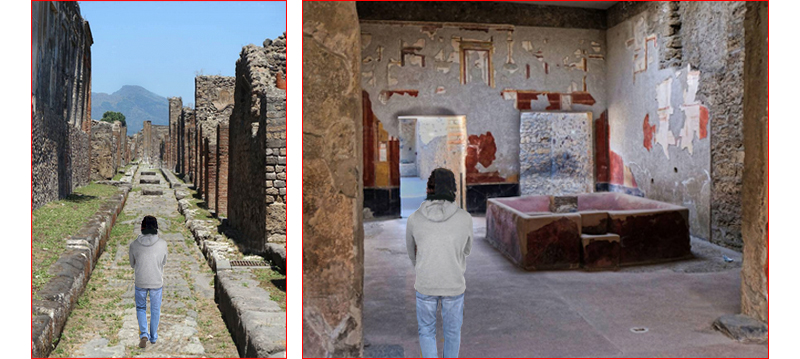
I read that the residents of Pompeii likely died from inhaling toxic volcanic gases and ash, leading to asphyxiation. After their deaths, bodies were quickly covered by layers of ash and other volcanic material, which hardened and preserved their forms.

After our unsettling experience exploring Pompeii, we moved on to Naples, often considered the birthplace of pizza—although I'm not sure how true that is. Regardless, we were eager for a more positive experience. We discovered a local pizzeria that looked inviting and decided to indulge. The pizza was absolutely worth it and delicious. We settled in for the night, ready for the morning ahead.
I was looking forward to Rome—all those images from my art history courses! The Colosseum, the Roman Forum, and the Pantheon—not to mention the Sistine Chapel at Vatican City. It was early in the day when we arrived in Rome. Horns blasting as road-raging Italians drove recklessly through the streets. Thankfully, Tommy was driving because he had a lower tolerance for stress than I did. We were trying to navigate the narrow streets toward the American Express office as we needed to exchange some currency.
All of a sudden, on a narrow street, a parked Fiat car door flew open as we were trying to pass—as luck would have it, we basically pancaked that Fiat's door against the front of the car. We immediately stopped, I jumped out and confronted the Fiat driver, and asked him,
"What the Hell?"—actually, I used another epithet.
He was not hurt and started yelling at me in Italian as I was yelling back at him in English. I soon realized that nothing would be accomplished with this interaction, so I jumped back in the van and told Tommy to step on it—hoping that he didn't get our license plate.

As we drove on, we wondered if the basic car insurance we had purchased in Amsterdam would cover any potential claims arising from this encounter. No matter, this was our adventure, and we were going to persevere. We exchanged some currency at American Express, located a room for the night with a bath no less, and planned our next Rome excursion.
Recharged and refreshed, we checked out of our room the next morning. Our goal was to visit the Colosseum and possibly the Vatican, especially the Sistine Chapel, to view one of Michelangelo's masterpieces. As we came to the van, something looked amiss—the side doors were flapping in the wind. Yikes! We have been ripped off.
Turns out they took both of our cameras—my Mamiya C330 and Tommy's Pentax 35mm. Nothing else was taken, not even the skis I purchased in Vienna—go figure.
I was more annoyed and upset than Tommy about our van break-in. My degrees were in art and photography, and I was looking forward to documenting all of our adventure arrivals on film. Once I remembered that "shit happens", I realized I had shot 9 rolls of Tri-X, 400 so far, that were tucked away in my duffle bag—what would they want with that?
We gathered some composure and made our way to the Colosseum. Adding insult to injury, ironically, the Colosseum and the Roman Forum were both closed. We later found out that the closure was due to falling stones caused by bad weather, traffic, and air pollution.
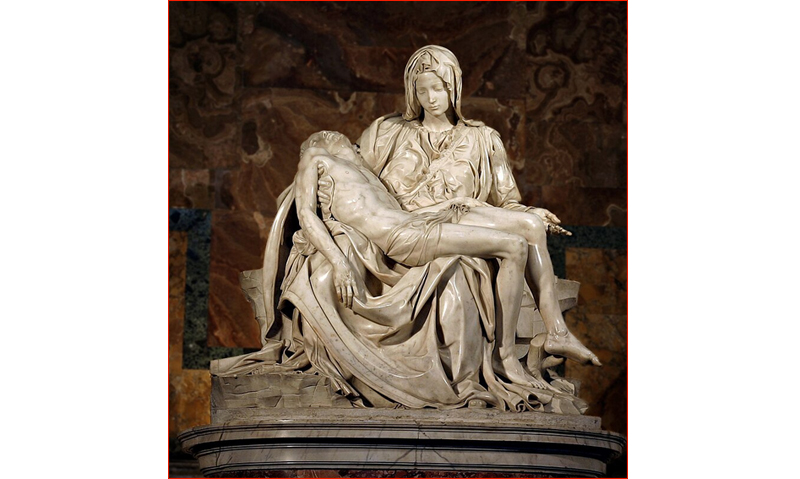
We went on to St. Peter's Basilica, located in Vatican City, as we both wanted to see Michelangelo's Pietà as well as the Sistine Chapel. The Pietà, Michelangelo's depiction of the moment when Jesus, taken down from the cross, is given to his mother Mary, was, as expected, magnificent; not being religious, seeing it in person was a genuinely moving experience.
The Sistine Chapel was awe-inspiring and sent chills up my spine—I was surprised at how narrow the chapel was, as the scale was something I didn't see from a slide show in an Art History course. Michelangelo painted the ceiling and the back wall of the Chapel, The Last Judgment, which I particularly found extraordinary—especially the self-portrait of St. Bartholomew holding Michelangelo's flayed skin (a self-portrait) in The Last Judgment.

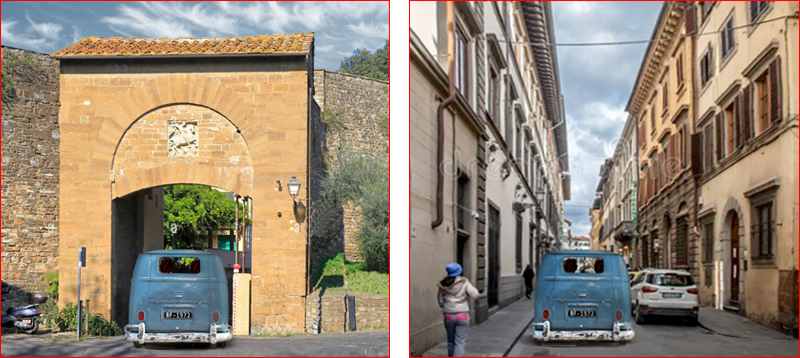
We drove on to Florence and arrived late afternoon, we decided to camp outside the southern entry gates for the night. In the morning, we made our way into the once-walled city through the south entrance, a stone gateway to the old city. Driving into Florence, we had another mishap on the narrow streets—yep, we managed to take off a side view mirror on a parked car this time while trying to find a parking spot. Are we having fun yet?
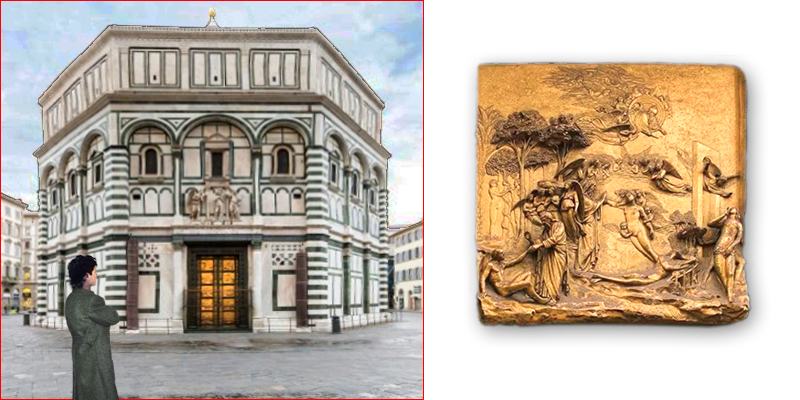
Our first stop was to see Lorenzo Ghiberti's Gates of Paradise (coined by Michelangelo) at the Baptistery of St. John. I read that in 1401, Ghiberti spent 21 years (1401-1422) creating a pair of gilded bronze doors that depicted scenes from Jesus's life—beautiful and stunning. I took a moment and reflected on how we think about what we are supposed to believe in.
We went on to the Galleria dell'Accademia to view Michelangelo's David. As expected, it was moving and inspiring. I especially loved seeing the details, something that I didn't get in an art history course back in the day—and to think this was carved from a single block of Carrara marble.

On to the storied city of Venice. Somehow, I couldn't fathom taking a gondola ride with my friend Tommy, as I thought that would be more appropriate with the opposite sex. Instead, we opted to visit Saint Mark's Square, where we encountered the infamous pigeons.

It is said that in some cultures, pigeons can be seen as a sign of good luck. I say, a rat with wings just landed on my head, and I hope the thing doesn't defecate.
We visited St. Mark's Basilica and viewed paintings by Canaletto and others, but it was getting late, and we were hungry, so we found a second-story restaurant that looked interesting. It was a good choice, as we found great pasta and wonderful people.

We just had to journey to Cortina d'Ampezzo in the incredible Dolomite Alps, home of the 1956 Winter Olympics as well as the 2026 Olympics —a short 2-hour drive from Venice. As a young lad, I remember watching the winter games on TV and being especially fascinated by the ski jump venue.
Driving to Cortina and experiencing the Dolomites was nothing short of spectacular—the ragged peaks and cliffs were dramatic and breathtaking.

On to Milan to view Leonardo Da Vinci's Last Supper at the Basilica di Santa Maria delle Grazie, The Duomo di Milano (the storied cathedral), and possibly sample some award-winning Milanese cuisine.
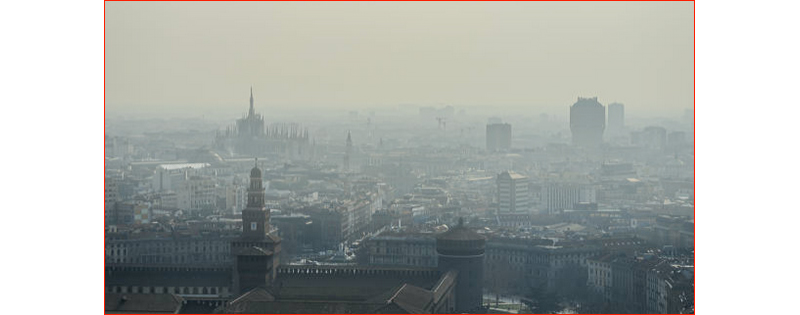
Well, we arrived in Milan around midday and were startled to see the air quality was as bad as it gets—sort of reminded me of L.A. on a bad day. We decided that breathing this air might be our "Last Supper," so we decided to make a 3½ hour run for the French Riviera on the coast as we missed the beaches and had enough religious art for a while.
France: Həˈlō
Spanning from the Italian border to roughly St. Tropez, the French Riviera (Côte d'Azur) was spectacular—an understatement to say the least.
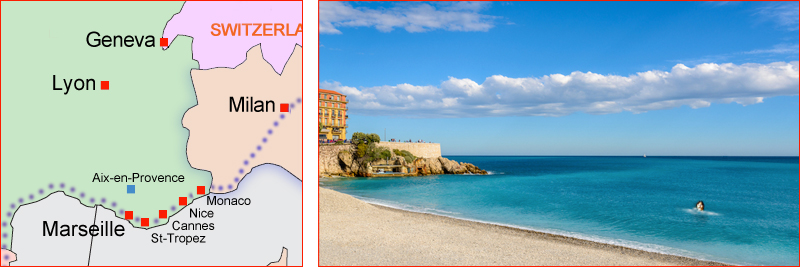
Tommy and I were not into gambling, so when arriving in Monaco, we decided not to indulge—although I can't say we weren't tempted.
We encountered many beautiful sites along the Côte d'Azur as the weather was cooperating. We spent a couple of days along the coast, stopping wherever we could to rest and enjoy the beaches—rocky and very different from the sandy beaches of my home in SoCal.
Marseille was our next stop, and we had read that the seafood was especially enjoyable. Arriving after dark, tired and hungry, we found a restaurant/market along the coast and decided to get some sustenance. The shrimp looked especially enticing, so I ordered a plate—can't remember what Tommy ordered.
We sat down at a table, and after a while, our meal arrived. I thought that the shrimp would be cooked, but mistakenly, they were raw on the plate—not a tradition in France. Okay, now I get it, the restaurant employees were making a statement about us long-haired Americans. This was our introduction to the uppity French!
Guess what! I ate the damn shrimp shells and all, and I can't say they were as delicious as if they had been cooked.

We settled down for the night in the van, thinking of visiting Mt. Saint-Victoire in Aix-en-Provence in the morning. I always wanted to see the mountain that Paul Cézanne painted multiple times. Instead, we both agreed to forego a visit to Provence and continue on down the coast, setting our sights on Barcelona, Spain.
We left Marseille in the morning and made our way to Barcelona—about a 5½ hour excursion. On our drive, we joked back and forth about our French restaurant experience. It wouldn't be our last as we planned to splurge for our birthdays at a 4-Star restaurant in northern France—more later.
Spain: Hola!
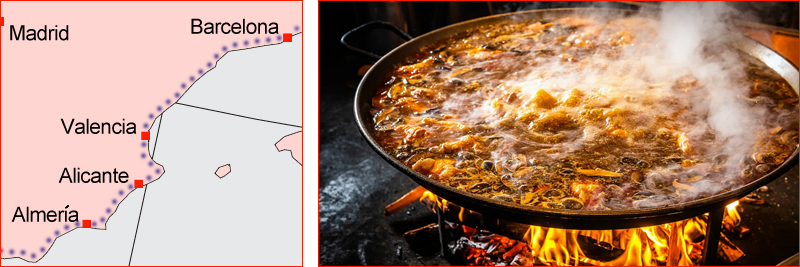
Paella, Antoni Gaudí architecture, and Flamenco were our priorities when we reached Barcelona, Spain—not necessarily in that order. The Paella didn't happen, the Flamenco didn't happen, but the Antoni Gaudí architecture did. We walked the streets, engaging with the many examples of this 19th-century Spanish architect and designer's work. I was not a huge fan then, but appreciated his contribution to the Art Nouveau movement.
Casa Batlló was especially interesting. Since our cameras were stolen in Rome, the photo below is by Nico Trinkhaus Photography.

I was glad to finally be out of France for a while and excited about our journey to Spain. We made our way down the coast toward Valencia, home of the traditional Spanish rice dish, Paella Valenciana. I was unsure how Tommy, as a vegetarian, would handle it, since the authentic dish includes chicken and rabbit. We found a restaurant close to the beach that looked inviting and indulged in Paella Valenciana—delicious. Curiously, Tommy actually ate some of this dish. Satiated, we settled down by the stunning beaches and ended up spending more time enjoying the Mediterranean.

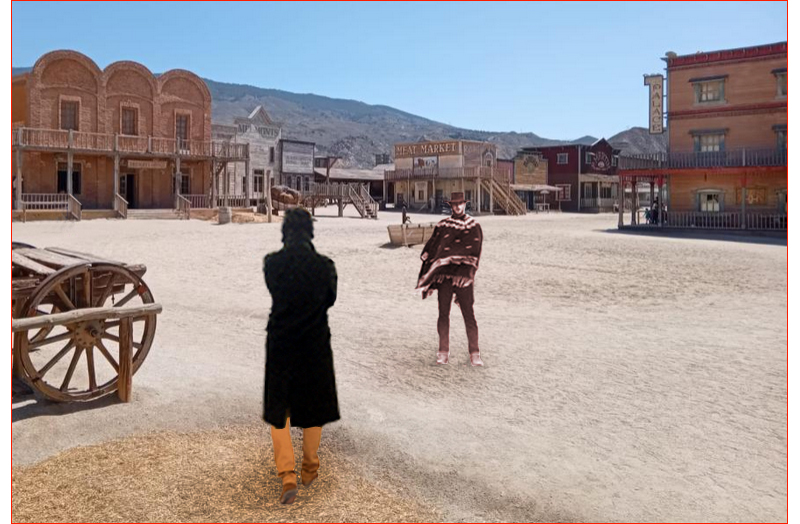
Still clinging to the coast and camping on the beach for the next few days, we wound up in Almería as we wanted to visit a spaghetti western location in the nearby Tabernas Desert—interestingly, Europe's only desert. We were not disappointed. Leone's 1964 A Fistful of Dollars, 1965 For a Few Dollars More, and 1966 The Good, the Bad and the Ugly, to name a few, were partially filmed there.

We went on to Gibraltar, then to the beach at Tarifa—stunning. There, we met some fellow travelers from the UK who were also camping. Watching the sunset, sharing a meal, and exchanging stories around a campfire while gazing at the Moroccan coast in the distance was a memorable experience for us. As expected, the Spanish police showed up to check on us, but since we had no drugs, they left us alone.
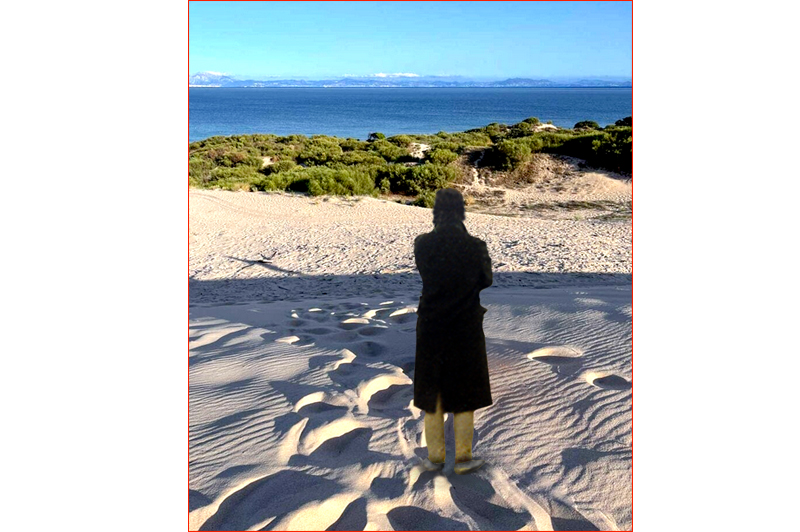
Sevilla: My Absolute Favorite!
We found ourselves in the historic city of Sevilla, Spain. I was, and still am, enthralled with Spanish culture, particularly flamenco dance and music. Sevilla was to be one of my more memorable experiences.
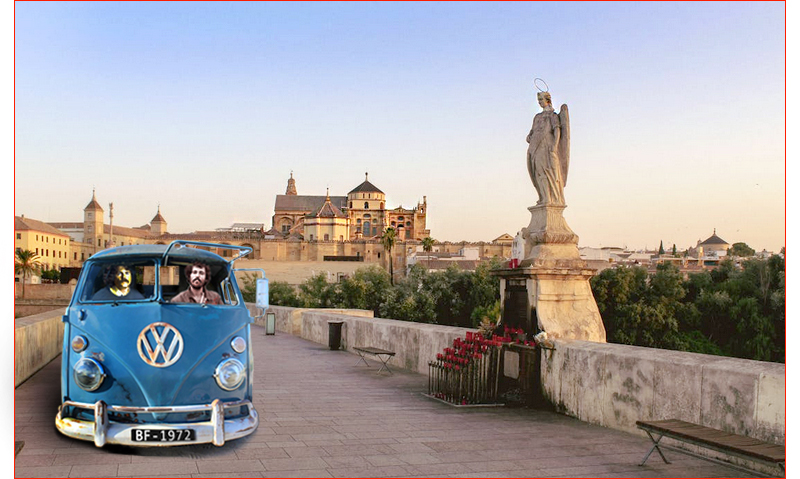
We arrived in Sevilla late in the day and parked our van along the Guadalquivir River. We were so excited to experience the city, the art, the food, and the people. It was a warm Fall day, and we were tired from driving most of the night. After a brief nap, we decided to take a walk and soon found ourselves in a crowded Tapas Bar, indulging in excellent Spanish appetizers and local beer.
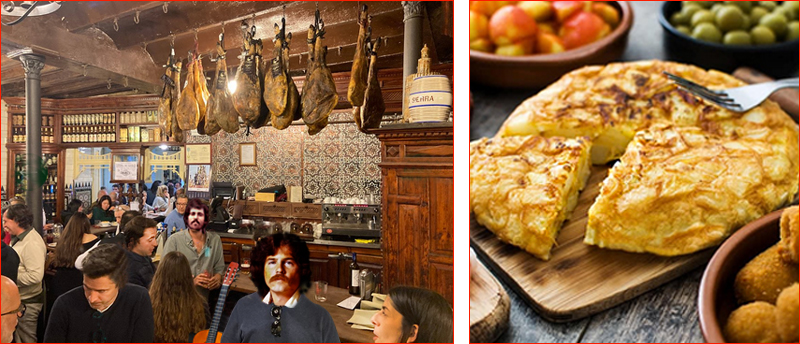
After a time, a young man with a guitar case came in and sat next to us at the bar. We introduced ourselves, and I tried my ridiculous high school Spanish on him, but to no avail.
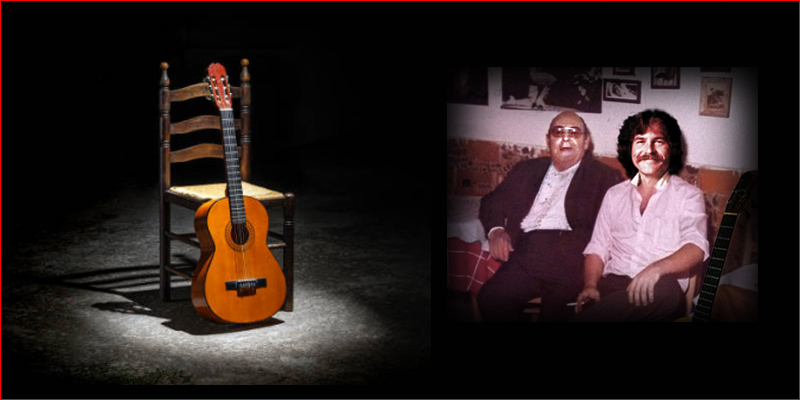
The young man, Rafael, could speak enough English for at least Tommy and me to understand. I recall that his guitar case had many stickers from all over Europe, and I asked him if he would show us his guitar. He opened the case and, voilà, I immediately noticed that the tuning pegs faced perpendicular to the fretboard, indicating a Flamenco guitar— Rafael was a budding Flamenco guitarist.
After a few more beers, some Tapas that Rafael recommended, and many conversations about Flamenco, Rafael asked us if we would like to join him to see Flamenco with his mentor and dance master, Enrique El Cojo—what were we to say? We were into it.
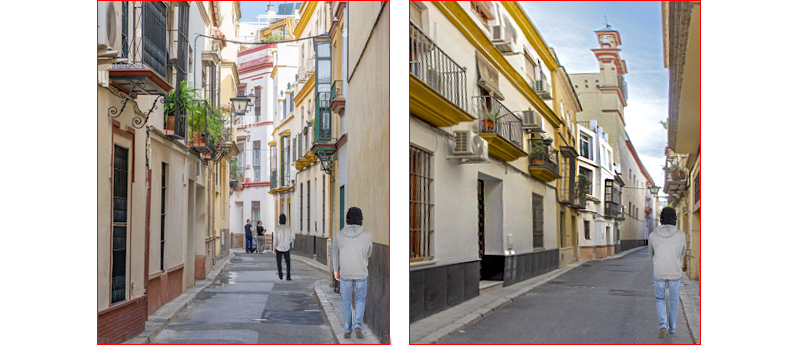
Rafael walked us down endless narrow back streets in Sevilla for half an hour, and I became a bit worried that we might be being played as I had no idea where we were in relation to our VW van, and it was also getting late in the day. We finally arrived at what looked to be a small storefront. It was actually the home base for Enrique El Cojo, who, I found out many years later, was one of the premier Flamenco dance masters, choreographers, and teachers in Spain. Enrique has a street named after him in Sevilla — Calle Enrique El Cojo.
We were invited into the small storefront room with a raised wooden floor, called a Tablao that enhances the dancers foot movements. Chairs lined the two outside walls, with Flamenco dance artwork above them and a small table and chairs on the back wall.
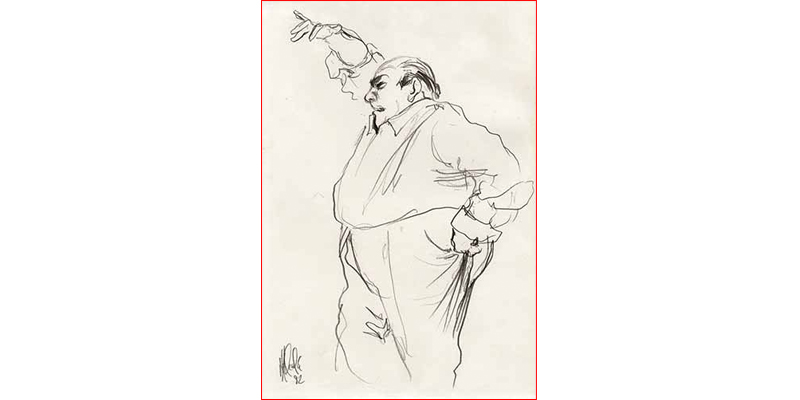
A small, portly man got up from the table and approached us. He had an engaging smile that ran from ear to ear—I noticed a slight limp. Raphael introduced us to Enrique El Cojo. He was not someone you would expect to be a Flamenco dance master, and I learned later he had developed a tumor in his leg at age 8 that left him with one leg shorter than the other, obviously affecting his making certain dance moves. Consequently, he developed ways to give a feel to a dance move rather than a physical one.
We were asked to sit down for a performance rehearsal with Enrique's students. Rafael was one of the guitarists for the rehearsal, and I had goosebumps when they started to play. After a moment, a female dancer appeared from a back room, and then a male dancer.
Rafael began what I believe was a Bulerías (to shout or mock in English) as Enrique started the rhythm with expression sitting at the small table. He shouted out instructions to the dancers while they performed. For the next hour, we were privileged to see the most beautiful flamenco dance and music I had ever experienced.
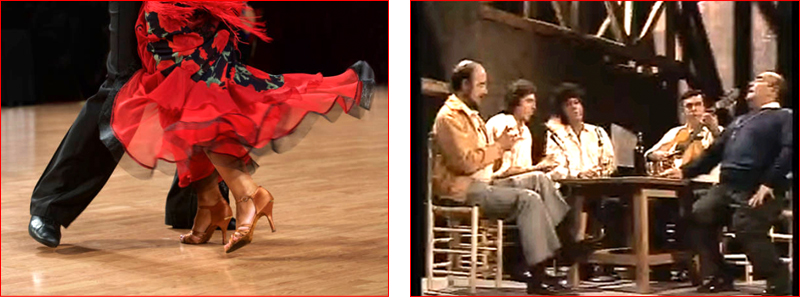
Tommy and I were the only audience, and I felt we were transported to another time and space. After the performance, we were exhausted yet energized by the passion of the performers we had just met by accident who invited us into their lives. I felt that I had finally realized why we had decided to drop everything at home and come to Europe that year.
After the performance, we said our goodbyes to Enrique and thanked Rafael for an engaging, beautiful, and inspiring experience. We asked Rafael if he could guide us through Sevilla's myriad back streets to find our way back to our VW van.
Before we parted, we exchanged addresses with Rafael to keep in touch as he wanted to come to America at some point, and we thought we could sponsor him. I communicated with Rafael for many months after I returned home, but the letters became few and far between. I often wonder what happened to Rafael.
Tommy and I experienced many European adventures that year, but this was one of my most memorable.
Theives: Not Again!
They say that with the good comes the bad, and you need to deal with both. Okay fine… When we arrived at our van after our incredible Flamenco experience in Sevilla, we found the side doors of the van flapping in the wind—Yikes, Rome again?
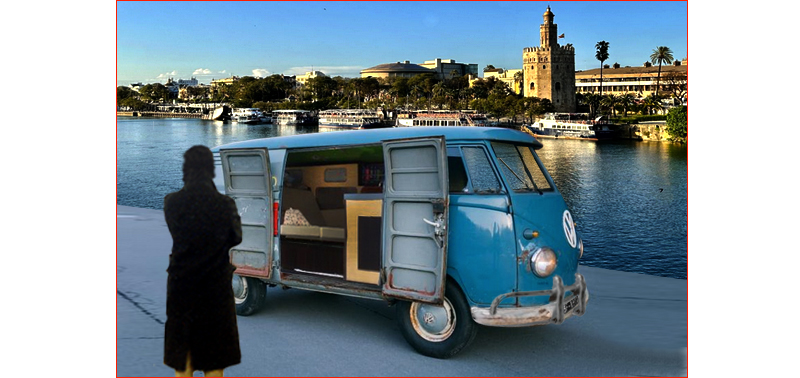
This time, the thieves took Tommy's diary, which he had been keeping and writing in every evening of our adventure, and his classic hair-cutting shears, which he cherished. Strangely, the skis I bought in Vienna were still there–not sure why they wouldn't take them as well.
Undaunted, we went on to Córdoba, as I wanted to see the birthplace of the famed bullfighter of the 1940s, Manolete.
While I don't condone the cruelty of the practice of bullfighting, I do love the artistry involved. Back in the day, I had read and viewed numerious films of Manolete's ease and creativity in the ring that was beyond question, as he was one of the greatest bullfighters in history. Gored over 11 times during his career, Manolete was fatally gored by a bull named Islero of the fierce Miura strain at the corrida of Linares in 1947.

Lisbon: A Long Drive!
We just had to visit Portugal, a long 5-hour drive from our location in Córdoba, Spain. It didn't disappoint, as it was a beautiful drive through vast fields of cork trees, olive groves, and vineyards, occasionally interspersed with quaint whitewashed villages.

Arriving in Lisbon, we settled down in the van for the night on a side street.
In the morning, our focus was to visit the beaches, especially the nude beaches near and around Estoril—what would you expect from a couple of mid-20s hetero boys!
We arrived at Rio da Prata, an official nude beach. We read that sunbathers here slathered themselves with mud as a natural sunblock. After it dries, it's rinsed off with ocean waters.
We found wonderful beaches in Portugal but no naked ladies and didn't lather ourselves with mud!On to Madrid —another long drive, but much anticipated.

Back to Spain: Can't Wait!
We arrived in Madrid ready for the exceptional art, a bit of the renowned nightlife with Flamenco, and of course, more delicious tapas. We decided to splurge and rent a room for a few days. We found a great hotel, and settled in at The Hotel Pintor Goya in central Madrid—named after the famed Spanish painter and printmaker Francisco de Goya.

Settling into our hotel and getting used to the Spanish city life routine was certainly interesting. Typically, work starts around 9:00 AM, with a long midday break for lunch, followed by a long siesta. Then, a late dinner at around 9:00 PM—Yikes. After that, party time into the night. Guess what, I sort of liked it.
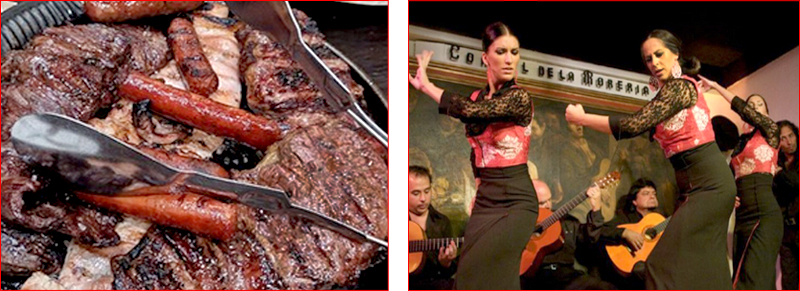
We walked to a local Tapas bar and indulged in more of those delicious appetizers. After a nap back at the hotel, we wound up at the Corral de la Moreria restaurant, renowned for its Zambra-style Flamenco—we were not disappointed. If I am not mistaken, we ordered a few shots of Grand Marnier while enjoying more Flamenco—memorable, but not as special as our one-on-one experience with Enrique and Rafael in Sevilla.
The next day, we decided to visit the Prado Museum, which houses one of the most astounding collections of European masterpieces. Since I studied printmaking in college, I especially wanted to see the etchings and paintings of Francisco de Goya, as well as other essential artists—Hieronymus Bosch, Diego Velázquez, and, of course, El Greco, to name only a few.
It's hard to find words for what I experienced that day as the Prado was, and still is, one of my favorite museums.

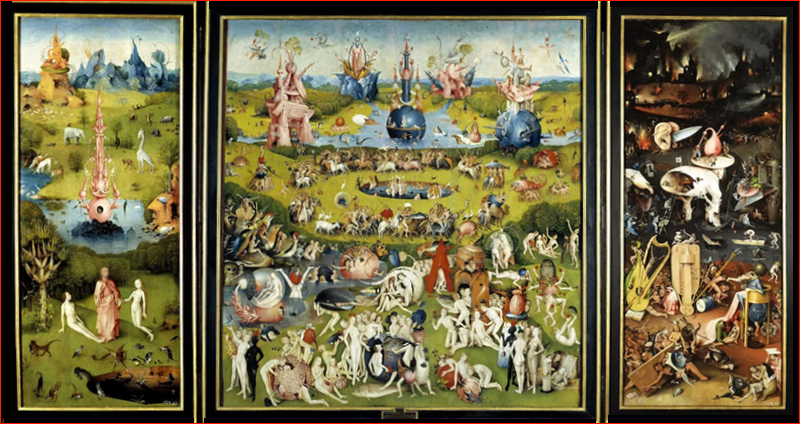
I recall a lecture from my European art history course on Hieronymus Bosch, a 15th-century Dutch painter who was renowned for creating strange and bizarre, surrealistic worlds. Probably his most famous work in the Prado is The Garden of Earthly Delights. Some favorites follow.

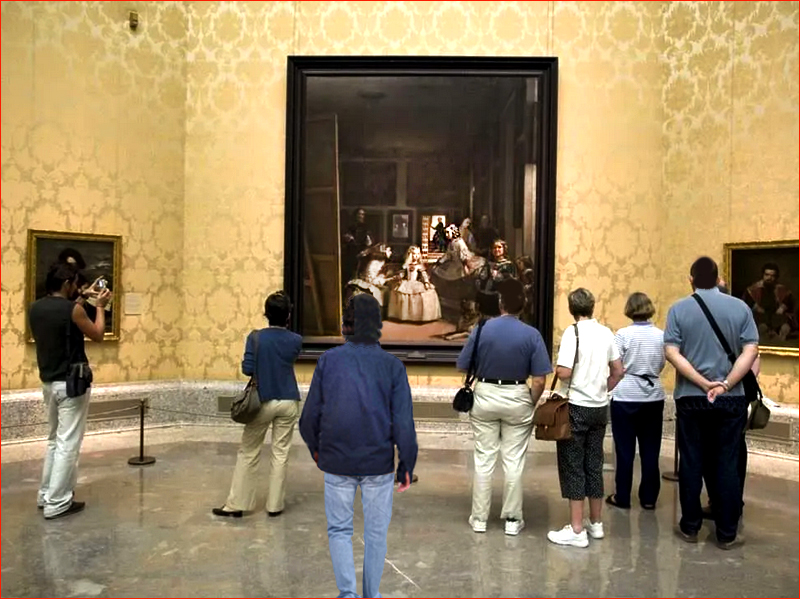
The mesmerizing Diego Velázquez 1656 painting, Las Meninas—The Ladies-in-Waiting.
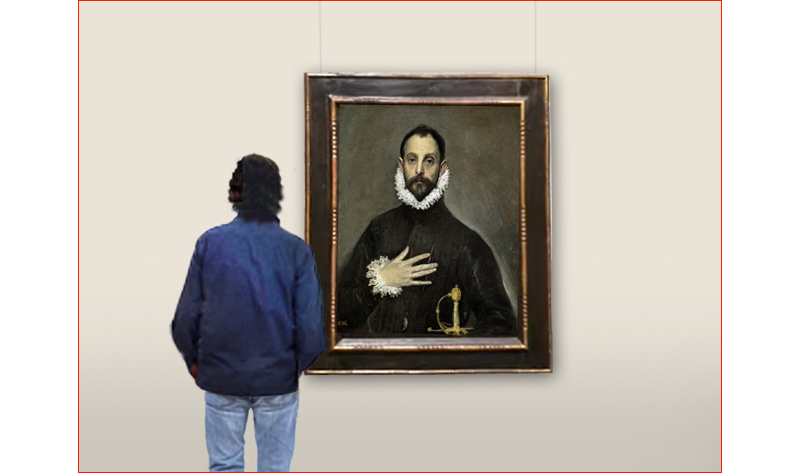
The expressive El Greco 1580 painting, The Nobleman with his Hand on his Chest—debatable meaning, but it doesn't really matter.
A wonderful experience, but my most admired were the Francisco de Goya rooms—especially engaging and inspiring to me.
Goya was one of the most important Spanish artists of the 18th century. I love the Goya restrike print I bought at an auction in 1966—a print made from the actual plate after the original run. It's from The Disasters of War series—Goya's reaction to the carnage of Napoleon invading Spain in 1808. Very disturbing but beautiful examples of Goya's extraordinary talent.
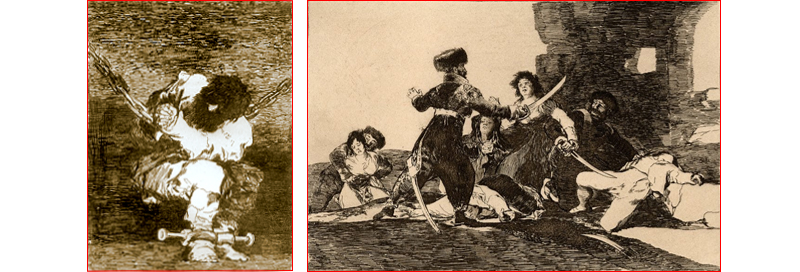
We viewed many inspiring Goya collections at the Prado that day. Still, I recall stories from one of my art history courses about The Naked Maja and The Clothed Maja, painted by Goya around 1800—complicated but interesting. I read that the Maja term refers to a woman from the lower classes of Spanish society in late 18th-century Madrid.
One story suggests that the Spanish Prime Minister commissioned Goya to paint a naked woman for his private collection, as he had a separate space reserved for nude paintings.
Another says that Goya was having an affair with a married young woman and painted both The Naked Maja and The Clothed Maja at the same time, only showing the clothed version to the husband.
Okay, fine, but to me, it really didn't matter one way or the other, as the experience of viewing these paintings was second to none. At least we finally experienced naked ladies!
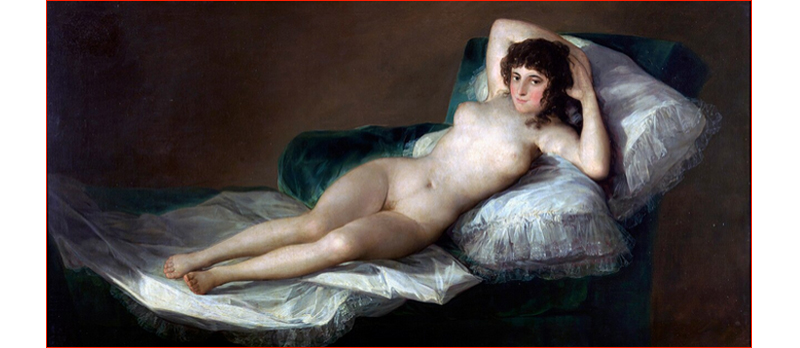
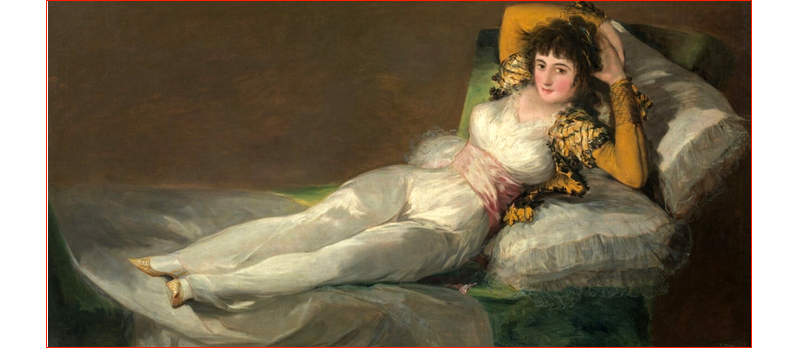
Compared to our Flamenco experience in Sevilla, the Prado Museum, and especially the Francisco Goya rooms, were my favorite.
France Again: Yet Another Long Drive!
Another long drive (a little over 11 hrs.) and on to France again. I was hoping the French would be more accepting of us long-haired Americans. I'm a bit fuzzy on this, but didn't we liberate them in some sort of war a few years back? Okay, granted, they did help us win our Revolutionary War—I will give them that, but not a reason to be uppity.

We set our sights on Lyon to taste award-winning cuisine, drive through the Rhône River Valley, and sample the region's renowned wine—we were not disappointed.
Driving up the Rhône River Valley toward Lyon after seeing and photographing the source of the Rhône at Valais, Switzerland, was remarkable. Thinking back, it does remind me of my home in Sonoma County today.
Lyon is considered the gastronomic capital of France, and we were looking forward to experiencing some interesting cuisine. We parked the van and walked over the Passerelle Saint Georges bridge in search of a bistro to try some typical Lyonnaise food.
We found a local bistro that turned out to be a delicious experience. We both ordered a traditional Salade Lyonnaise—bitter greens, bacon, crotons with a mustard dressing, topped with a poached egg. Tommy had the vegetarian version—sans bacon. It sort of reminded me of Nasi Goreng, the dish we had in Amsterdam—of course, without the rice.

I wanted to visit the tomb of Leonardo da Vinci in Amboise, not sure why, but I was compelled after reading conflicting stories about why he was buried there. I recall from an art history class that in his later years, da Vinci was invited to live in France by King Francis I, who was a patron of his work. Another cited a long feud with Michelangelo that prompted him to move.
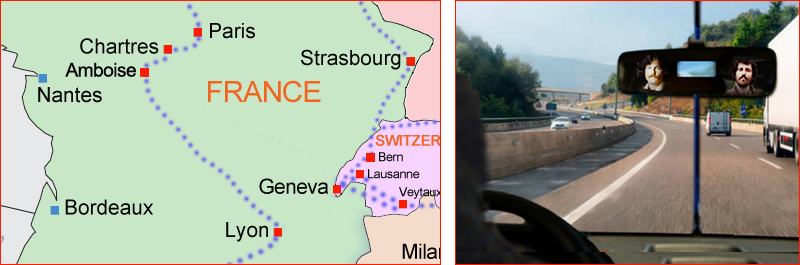
It didn't really matter, as just visiting the beautiful chapel was enough for Tommy and me.

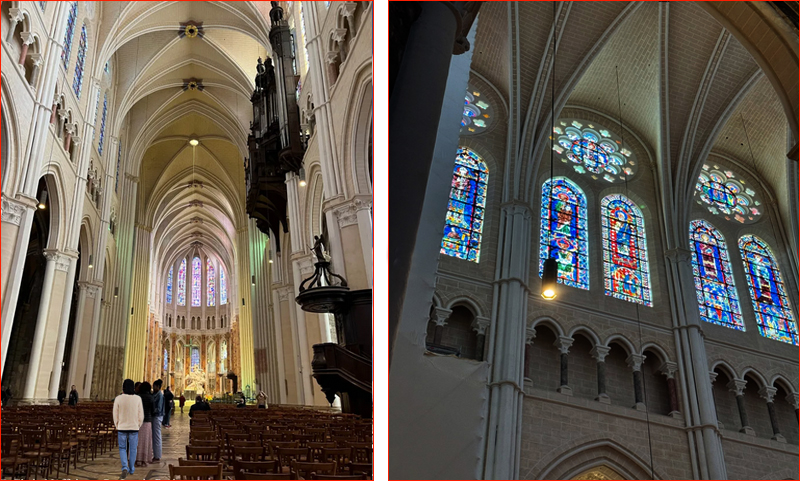
We decided to spend the night in Amboise and move on up the Loire Valley to Chartres the next morning, and wanted to avoid the touristy château experience along the Loire. Our focus was to see the historic cathedral and its classic 12th-century stained glass. Arriving late in the morning, we settled in and parked the van near the cathedral.
Chartres was a fascinating experience. The gothic architecture and column figures, the many chapels and altars, not to mention the stained glass, were visually overwhelming.

We walked into what is called The Royal Portal of the cathedral—the main entrance. It was quiet, a few people were present, and, as we walked down the nave toward the high altar, voices began to sing. We were taken aback as a choir began with what I believe was a chant—the choir was practicing! We were both quite moved, and it sent chills up my spine.
I'm not a religious person, but if I were to think about having a spiritual experience, hearing the choir practicing at Chartres Cathedral that day would be it!
"Ah, Paris"
So much to see! We both decided to forego visiting Versailles, as we were ready for some urban Parisian experiences, not the least of which was the art, and of course, the food. The drive from Chartres to Paris was uneventful and was typical of the French countryside we had already encountered. As we neared Paris, the landscape became more urban, which made us nervous on the one hand and excited on the other.
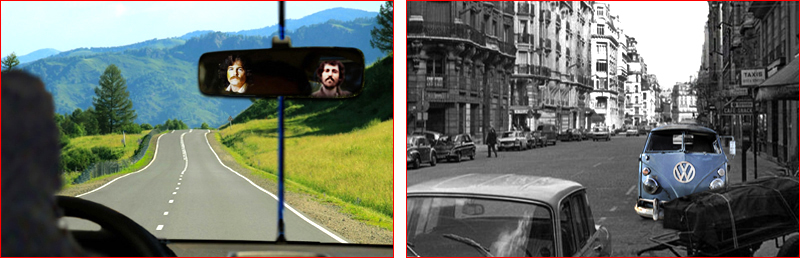
A couple of weeks earlier, we had booked a small boutique hotel not far from the Louvre on the right bank in anticipation of our arrival. After endless stressful driving around the city, we finally found our accommodations and parked the van.
It was a quaint, clean Ma-and-Pa hotel with 3 floors and 1 bath with a shower on each floor—couldn't wait! Better yet, the proprietors liked Americans and spoke good English. They became a wealth of knowledge for our Parisian adventure.
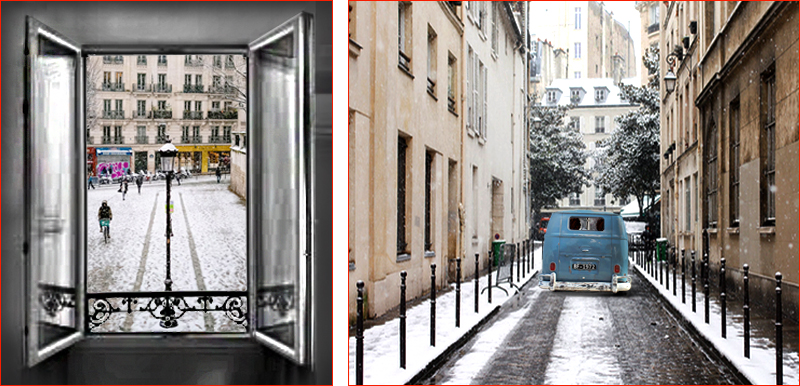
We settled in for the night and planned our next few days in Paris. Waking up the next morning, we found that it had snowed overnight, an unusual occurrence, but well-received by us.
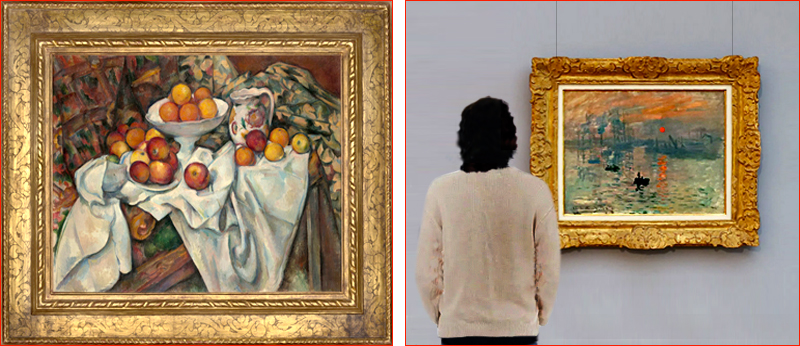
The classic Musée du Louvre, the iconic Eiffel Tower, and the historic Montmartre neighborhood, yikes, where to start! After a visit to the American Express office to exchange some currency (we had no cards in those days), we decided to visit the Louvre. With over 400K art objects to view, we would need to rent a room there for the next few years to see all of the art. That said, here are a couple of my favorites.

Spending a couple of days at the Louvre was visually overwhelming, so going back to our hotel at the end of each day was welcome. The next morning, we wanted to visit the Musée du Jeu de Paume—the then Impressionist museum in the Tuileries garden. In 1947, the Louvre's Department of Paintings had the Impressionist collections moved to the Musée du Jeu de Paume, where they were exhibited until they were transferred to the Musée d'Orsay in 1986.
Even though it was a very hot, very crowded day, with no air conditioning in the museum, it was a visually spellbinding experience to see the works of Monet, Degas, Cézanne, Gauguin, and many others. I was struck not only by the stunning artworks but also by the ornate framing on some paintings, which, to me, seemed to distract somewhat from the art.

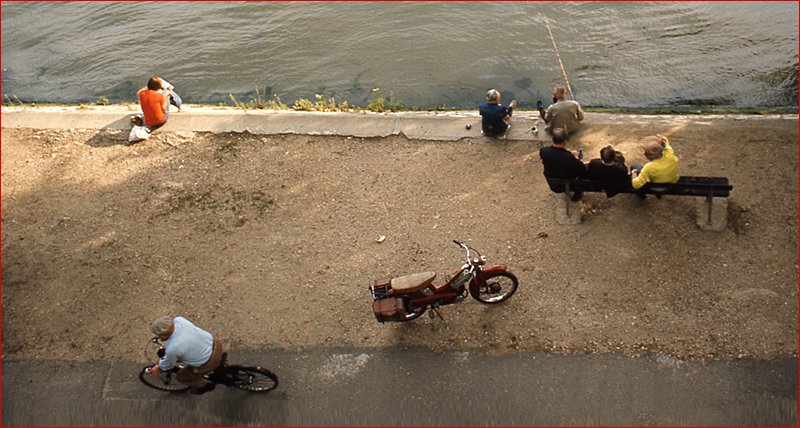
Neither of us wanted to visit the Eiffel Tower, other than seeing it from afar, as we were having too much fun visiting the museums and eating at the local cafes. We visited the Gothic cathedral of Notre-Dame one day and spent some time along the Seine. Since our cameras were stolen back in Rome, I took the shot below in 1974 on a return trip—yet another story, but not here.
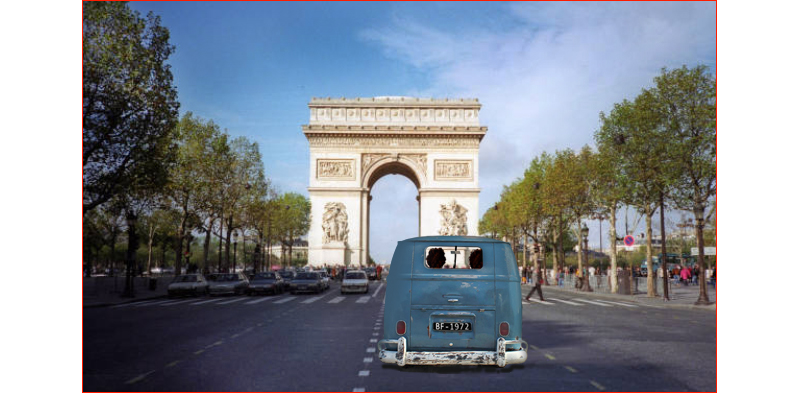
We did drive to the Arc de Triomphe one day. We got caught up in the classic congested roundabout that sort of reminded me of the 1985 film, National Lampoon's European Vacation, where the Griswold family couldn't get off a roundabout in London and spent the day going around and around. Thankfully, we were finally able to exit this roundabout.
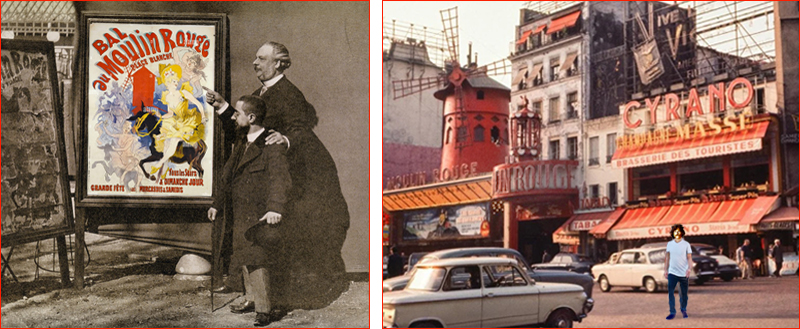
We did a day walking the neighborhood of Montmartre, known for its artistic past and bohemian atmosphere. A haunt for Picasso, Renoir, and Van Gogh back in the day, not to mention the classic cabaret, Le Moulin Rouge.
I was ready to move on, since it was December and I was getting antsy to get home. Tommy, on the other hand, was adamant about seeing a former girlfriend who was now living in Paris with her new French boyfriend. Reluctantly, I capitulated but wondered why you would want to visit a former girlfriend living with a new boyfriend?
Tommy contacted them, and they invited us to dinner at their apartment on the outskirts of Paris. To my surprise, we had a great time and a wonderful home-cooked dinner. Strangely enough, I hit it off with the boyfriend (can't remember his name) who spoke enough English for both of us to understand each other.
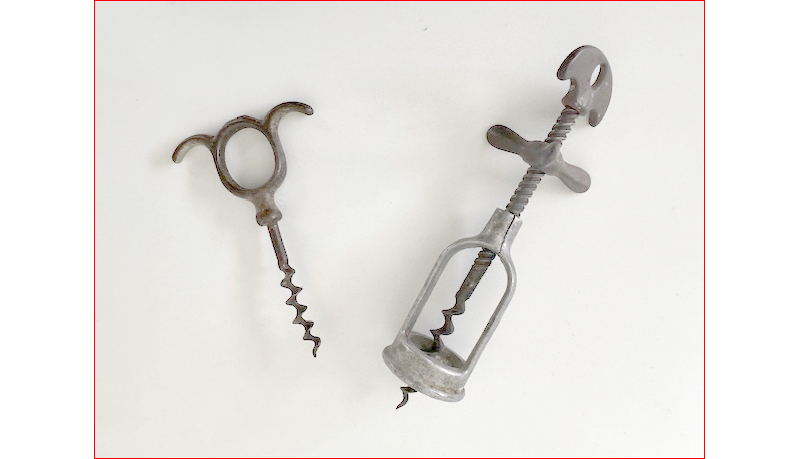
It was getting late, and we wanted to get back to the hotel so we could get started toward Rouen in the morning. As a final gesture, the boyfriend gave me 2 antique corkscrews he had, as we had discussed our mutual interest in good wine tasting—I will never forget that gesture, and I still have the corkscrews.
Anxious and excited, we made our way toward Rouen the next morning, taking back roads. We did plan to visit Claude Monet's estate and gardens at Giverny. Some rainy weather got in our way, so we pushed on toward Rouen, as our focus was to celebrate our birthdays indulging in some French culinary delights by visiting the Maison Troisgros in Rouen. We had read that the famous Michelin-starred family restaurant was one of the best—we were excited.
It was late afternoon when we arrived at Maison Troisgros and were seated—there were a few customers. We were seated at a table in the middle of a dining room surrounded by what I assume were French locals. As you might expect, we immediately felt a strange vibe, highlighted by smiles and chuckles from the surrounding local customers.
We ordered, and I requested Sweetbreads, as I heard they were especially delicious. I don't remember what Tommy ordered.
The dishes soon arrived on carts, and the servers displayed strange smiles—not unexpected. Appetizers, bread, the cheeses, and finally the entrée, followed by a dessert cart that we decided to forego, as the atmosphere in the restaurant was becoming a bit overwhelming for us longhaired Americans. That said, I do have to say that our meal was absolutely delicious.
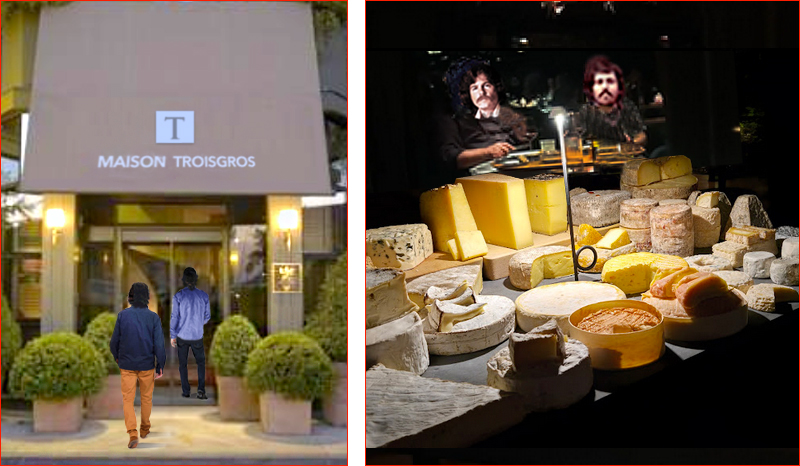
We spent the night in Rouen, parked in front of the restaurant, and reflected on our Troisgros birthday dining experience while being amused by the uppity French. We decided to move on to Calais for our crossing to the UK as we had had enough of France for the time being.
I previously wired my Mom and asked her to draw some funds from my account for a ticket back to the States and send it to the American Express office in London. I was anxious to catch a flight home before Christmas, but wanted to experience a bit of the UK first.
We pushed on to Calais to catch a ferry to the UK, anticipating a few new adventures—namely, London, the museums, the countryside, and, of course, Stonehenge. Aside from a brief road encounter with a belligerent highland cow, the arrival at Calais was uneventful. We bought tickets, loaded up the van, took a deep breath, and continued.
The UK: Yes Indeed!
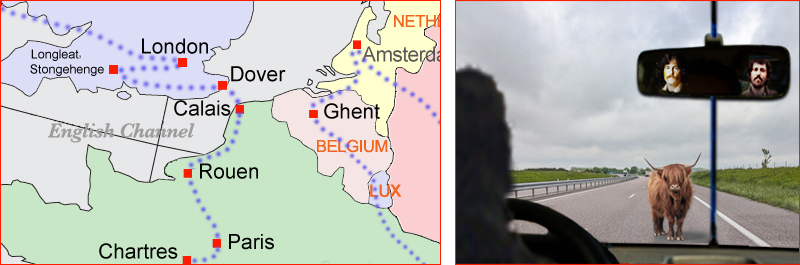
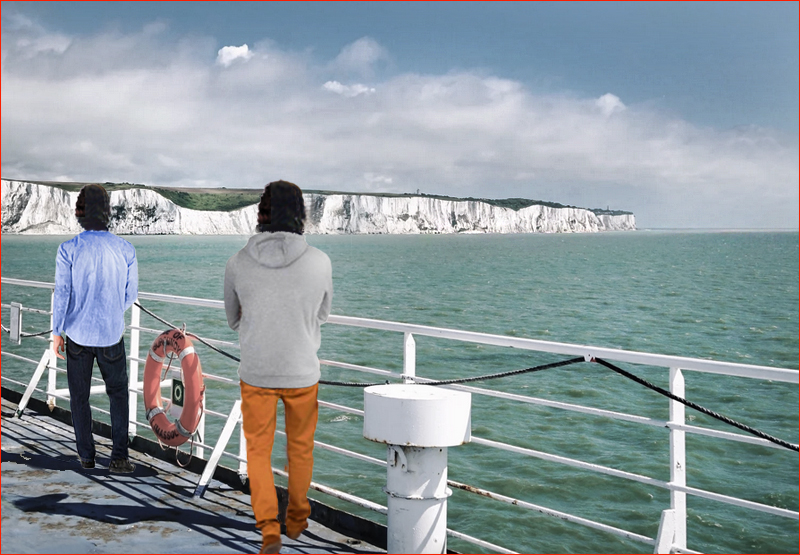
Since we were in Europe before the Channel Tunnel, the crossing to Dover had to be on the ferry. It was a great crossing and surprising to see the White Cliffs of Dover at a distance come out of the fog—Tommy didn't get sea-sick this time.
We decided to make our first stop in the UK, Stonehenge, the prehistoric megalithic structure I recall from my art history courses—couldn't wait. It was getting late, so we found a Guinness Inn nearby and decided to stay and visit Stonehenge in the morning. I decided to rent a room at the Inn, while Tommy, knowing he wanted to stay in Europe a bit longer and save some dollars, decided to sleep in the van for the night—it was freezing outside, and I wondered how he would do.

Not a problem for me as I indulged at the bar, ordering chicken and chips and a pint of Guinness. Finishing and satiated, I checked with Tommy in the van before going up to my room, and he seemed fine. As luck would have it, and as I might have expected, my stomach didn't cooperate with the chicken and chips. I became sick during the night and heaved up my chicken and chips. I made it through the night and recovered for the morning.

Then there was Stonehenge, the next morning, that mythical monument of rugged stones. What was it? A Druid place of sacrifice? A temple of the sun? A cathedral? Scholars have been speculating about Stonehenge for centuries. Just visiting the landscape and taking in the visual of this monument was enough for me.

We read about The Lions of Longleat, a safari park near Stonehenge. Apparently, it was the first drive-through safari park outside of Africa. Since we needed some diversion, we decided to visit. Well, we had no idea what we were about to encounter. We did see a few lions and some friendly giraffes, but decided to go through the Monkey Jungle—Yikes!

Don't get me wrong, I love animals, it's just that those revolting monkeys reminded me of certain annoying people I've encountered in my life. The rhesus-macaque monkeys were all over our van, playing with themselves, peeing all over, and trying to eat everything they could get their hands on—windshield wipers included.
We left Longleat with smiles on our faces about our collision with those disgusting monkeys and pushed on to London, as my departure back home to the US was getting close, and we both wanted to see a bit of London beforehand.
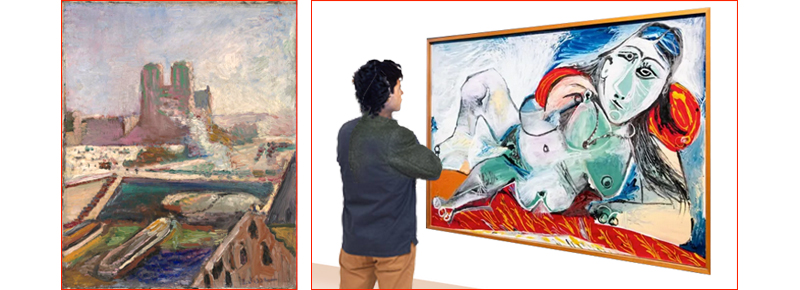
Arriving in London, we found a quaint flat centrally located, which allowed us to explore London mostly on foot. We both wanted to see the Lautrec lithographs at the British Museum, Picasso and Matisse at the Tate, and maybe, but not a high priority, the Crown Jewels at the Tower of London.
The massive British Museum, with over 8 million works, was almost as overwhelming as the Louvre. We limited ourselves to the extensive collection of lithographs by Henri de Toulouse Lautrec. I majored in printmaking and graphic design as an undergrad back in the day and found the collection quite inspiring.

The next day, we decided to do the usual tourist thing: riding public transit, visiting Buckingham Palace and Trafalgar Square, and finishing the day at the Tate Gallery.
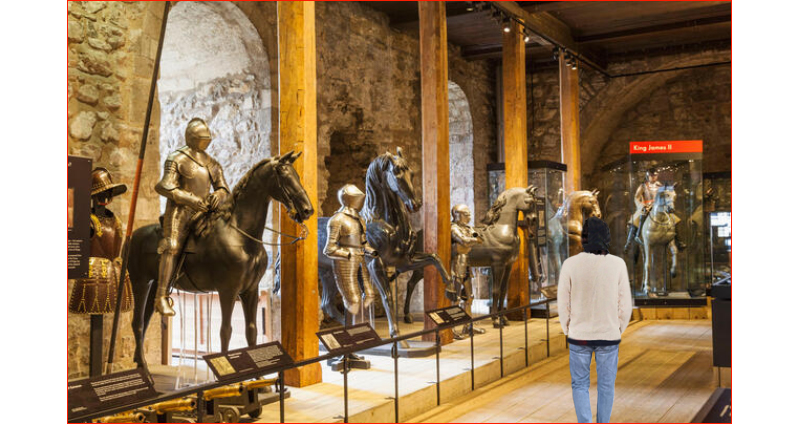
The Crown Jewels at The Tower of London were elegant and beautiful, but I was more taken by the Royal Armouries, a fascinating display of ancient knight armor and weapons in the White Tower.
After cornflakes and eggs for breakfast every morning, and then the Museums, we found ourselves wanting some musical diversion. We both liked a British rock group at the time, Emerson, Lake, and Palmer.
We bought tickets (about $3.50 back then) to a live concert they were giving at a local Odeon theater. It was nothing less than spectacular as they played their classics.

Below, From The Beginning, from the album Trilogy—classic. Sad that Keith Emerson and Greg Lake have passed as they were innovators. Carl Palmer is still performing at this writing.
It was months of adventure for us that year, traveling together for over 13K miles in our VW van. It was time now, time for me to get back to Santa Monica and work on my future. I picked up the airline ticket that my Mom sent to the American Express office in London.
The next day, I packed up my stuff, and Tommy drove us to the airport. It was a quiet drive to Heathrow as we didn't speak much. We had just spent a good part of our lives together exploring our dreams and aspirations, and had found that we had become just a bit more mature human beings.
Tommy opted to go back to Paris to revisit his former girlfriend—couldn't figure that one out. Arriving at Heathrow, we hugged each other and parted, and I made my way to the gate for departure, with a tear in my eye.
The flight home felt longer than it probably was. One highlight after a short nap was seeing Greenland and icebergs!

A former girlfriend picked up my Mom and drove her to LAX, where they met me at the gate after I went through customs. It was great to see them, but I felt distant and detached even though I was glad to be home.
All I wanted to do was to get to my digs and relax. Before Tommy and I went to Europe, I was renting the back half of a secluded home in Brentwood, owned by the family of the late screenwriter Sydney Boehm. I didn't want to lose that place while I was away for some months, so my friend Rich agreed to live there until I returned.

Tommy's parents called me after my return, trying to find out when he would be coming home so they could send him an airline ticket. I had no idea, since he rarely shared his thinking with me until the last minute. Later, I found out that, with his parents' help, he came back to the States a month later.
I will always cherish the adventure Tommy and I had that year, and hope my grandkids can learn something about their grandpop with this writing.
