
Stories: Not Too Far From The Ocean
The End of Polio? • I Was a Long-boarder • The Draft: What's Your Problem? • Timothy Leary? • To Ski or Not to Ski • Butch and Sundance • Dogs, Dogs, Dogs! • Arrivals • It's Just a Car • Fish On! • Music Musings • Walter Mitty Redux • Clamming and Crabbing • Grandpop: Can We Talk?
The End of Polio?
 It was always in the back of my mind. Those days and the years that followed growing up with a poliomyelitis diagnosis in 1948 at the young age of seven. It lingers in the back of my mind constantly, and I am writing this because, unbeknownst to me, a good friend of mine also contracted Polio about the same time I did. We have been friends and collaborators in the creative arts for many years, but now it seems we share more than just our passion for the arts; we are both experiencing symptoms of post-polio syndrome (PPS). This disorder occurs when polio symptoms re-emerge years after the initial diagnosis.
Mom, Dad, and I were living in Santa Monica then, and I remember waking up one morning with a fever of over 104ºF and being unable to move my left arm. In those days, you could call a doctor, and they would actually come to your home. The doctor, concerned about my condition, quickly sent me downtown to Los Angeles County General Hospital, where I underwent a spinal tap. A spinal tap involves inserting a needle into the lower back to test for infection by removing a small amount of cerebrospinal fluid (CSF) for testing. A large black man, I assume a nurse, held me while another person performed the procedure—a frightening experience for a seven-year-old. After that, I was wrapped from neck to toe in a large, hot wool blanket. It wasn't until much later that I understood the purpose of that blanket.
I was diagnosed with polio and then transferred to Harbor General Hospital in Torrance, where I spent nearly a year in a barracks-like setting with other children and adults afflicted by the same illness. Harbor General had originally served as the U.S. Army's Los Angeles Port of Embarkation during World War II.
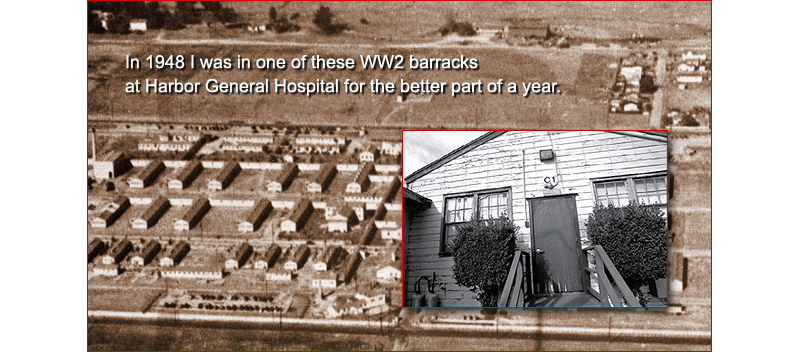
At Harbor General, I was placed in a ward with women and young girls, which was almost as frightening as the spinal tap and the hot body blanket. Eventually, with my parents' intervention, I was moved to an all-boys ward where about 30 of us young boys were in various stages of the disease—some were in iron lungs and others in full-body braces. I had no clear understanding of what was happening, and I suspect that no one else did either.
The adult males were housed in a separate section of the same ward, divided from us kids by a wall and a door—I'm not quite sure why. The interior of the ward resembled the image below but was not nearly as pristine and had fewer windows.
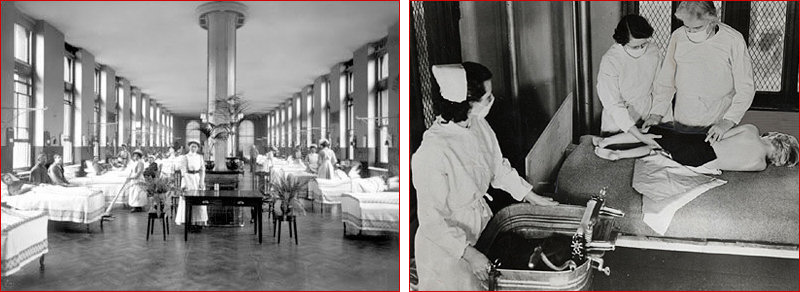
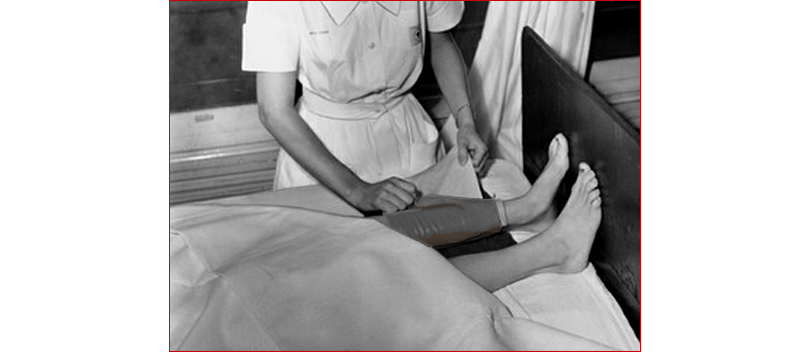
During the first few months at Harbor General, I was completely paralyzed except for some movement on the right side of my body. Daily hot wool pack treatments were administered to reduce spasms and pain; these were part of the Sister Kenny treatment. (see above).
Elizabeth Kenny was an Australian nurse who advocated for a new approach to treating poliomyelitis, emphasizing the importance of exercising affected muscles instead of immobilizing them. This involved using hot packs and hot wax. Nurses would roll in a tub of boiling water on a cart equipped with a wringer. The tub was filled with wool blankets cut to fit between the joints. The nurses would wring them out and pin them to the body, leaving them on for about 20 minutes. The blankets were almost scalding hot, making them difficult for the nurses to handle. I might have opted for the spasms and pain, as I still had no idea what the hell was going on.
Adding to my discomfort, I underwent paraffin wax treatments every few days. The nurses would bring in a cart with a Bunsen burner and melt the paraffin wax in a small tub. Once melted, they would flip me onto my stomach and brush the wax onto my back. After the wax cooled and solidified, they would peel it off. This treatment wasn't as bad; I found it worked better for me than the hot pack treatment.
I can't say I was the best kid polio patient at Harbor General in 1948, but I tried to make the best of what was happening to me. I made friends with a kid whose bed was on the opposite side of my ward. I found out later that he was a child actor at the time, Bobby Hyatt. From our beds, we would throw spitballs at each other made from toilet paper and water that would stick to the hospital walls—not appreciated by the nurses on the ward.
As some of us began to regain movement, we were occasionally allowed to use wheelchairs. Being boys, we naturally had wheelchair races up and down the ward. We crashed often, but we just wanted to have fun in an otherwise grim situation. The nurses did not approve of this behavior either.
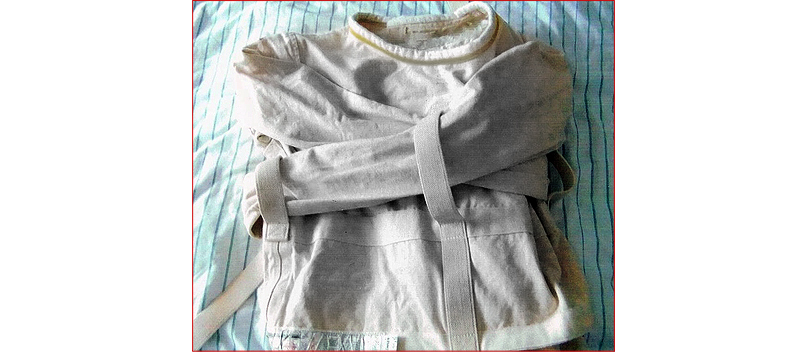
I also broke the rules by listening to the Lone Ranger and the Green Hornet on a small radio my parents had given me, not allowed. For my disobedience, the hospital staff confiscated my radio and placed me in a straightjacket for a few days—are you serious? It was terrifying, but surprisingly, I managed to wriggle out of it. When my dad found out they had taken my radio away and put me in a straightjacket, he confronted the hospital's doctor in charge.
Dad was a boxer in the Navy and didn't take any nonsense from anyone—especially me. As far as I know, Dad punched the doctor in charge but no charges were filed against him, and I did get my radio back, but I wasn't allowed to listen to it after the lights went down at night.
As for the food, what can I say about hospital food other than that it was essentially swill and the worst I've ever had? I remember being served chicken liver and rabbit parts periodically. The rabbit looked like it had been cooked in the same boiling water they used for the hot packs. After the nurses left, I would wrap it up and stow it on my nightstand next to my bed, along with the large purple pills they wanted me to take. When my parents visited, I usually passed my stash to them on weekends. To this day, I still have difficulty swallowing capsules, and the sight of the liver nauseates me. No wonder I was skin and bones when I finally got to go home.
Even though the entire experience was a nightmare, there were some things to look forward to in the hospital. On Monday nights, they would push our beds to the center of the ward and put up a screen. Then, they rolled out a cart with a 16mm projector to show movies—mostly Disney cartoons. This was yet another chance to be unruly. Those of us who could crawl would descend underneath the beds once the lights went down and cause chaos by sabotaging the adult patients' nightstands.
Finally Going Home:
After what felt like an eternity, I finally recovered enough to return home. I remember the drive home in my dad's sleek 1948 Oldsmobile, sitting in the back seat on a sunny summer day. It felt like I had been born again, finally seeing the beach and the ocean again.
Apparently, all the kids in our block had been informed I was coming home because they were all standing on the sidewalk waving as we passed by and turned down our street. Once home, I was quarantined in my room for a while since no one knew if I was still contagious—it would be a few more years before the Salk vaccine came out in 1955.
Rehabilitation:
When I was well enough to go back to school, I was placed a grade lower than when I left. This was fine because I made many new friends, some of whom I still keep in touch with today. Since I had muscle weakness and atrophy on my left side, I was sent to the Kabat-Kaiser Institute in Santa Monica, which was originally the Edgewater Beach Hotel. In 1944, it had been taken over by the Army Air Corps, and in 1945, it became the private Ambassador Club. In 1948, it was purchased by the Kaiser Foundation to be used as a physical therapy center (in the middle of the image below on Santa Monica Beach).
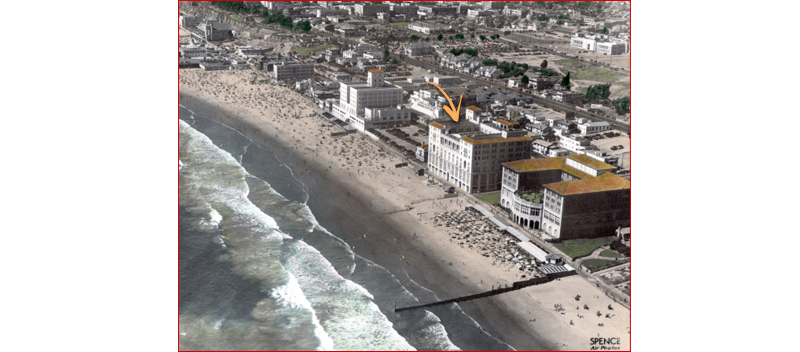
I recall going to Kabat-Kaiser for physical therapy sessions twice a week after school for about two years after my release from Harbor General. My routine focused on my left side, specifically my left arm and hand, but also included general exercises. The staff constructed an exercise board for my left hand, where my arm was strapped down, palm up, fitted with a cloth glove with rubber bands attached to the fingers, and secured to the board. This allowed me to exercise my whole hand grip for each finger, similar to squeezing a rubber ball. We also had periodic swims in the basement pool at Kabat-Kaiser and visits to the beach.
What's ironic about all of this is that some say I contracted Polio in the first place by swimming in a small lagoon on the very beach in front of the Kabat-Kaiser Institute in Santa Monica. It is now thought that one can contract the Polio virus by contacting sewer sludge. Later, that lagoon was proven to be contaminated with human waste.
Post Polio:
I feel lucky that I could recover to the degree that I have and live a seemingly normal life—whatever that means. That said, it seems that those of us who did recover to live a somewhat everyday life are having symptoms again 30+ years after the initial attack, with new weakening in muscles that were previously affected and those that were not affected as well. These days, they call it PPS (Post-Polio Syndrome).
As time would have it, the damn virus that took us when we were just kids has been with us ever since and is now rearing its ugly head again—are we having PTSD as well? Dealing with PPS is undoubtedly frustrating, but I find some comfort in the stories of others my age who are experiencing the same symptoms.
