Stories: Not Too Far From The Ocean
The End of Polio? • I Was a Long-boarder • The Draft: What's Your Problem? • Timothy Leary? • To Ski or Not to Ski • Butch and Sundance • Dogs, Dogs, Dogs! • Arrivals • It's Just a Car • Fish On! • Music Musings • Walter Mitty Redux • Clamming and Crabbing • Grandpop: Can We Talk?
The Draft: What's Your Problem?

Those of us who came of age in the late 1950s and early 1960s faced some daunting decisions as we turned 18, including registering for the draft. The Selective Draft Act, enacted in 1917, authorized the federal government to create a national army for service in World War I. Initially, all males aged 21 to 30 were required to register, but this age range changed to 18 to 25 by the time I reached 18 years of age.
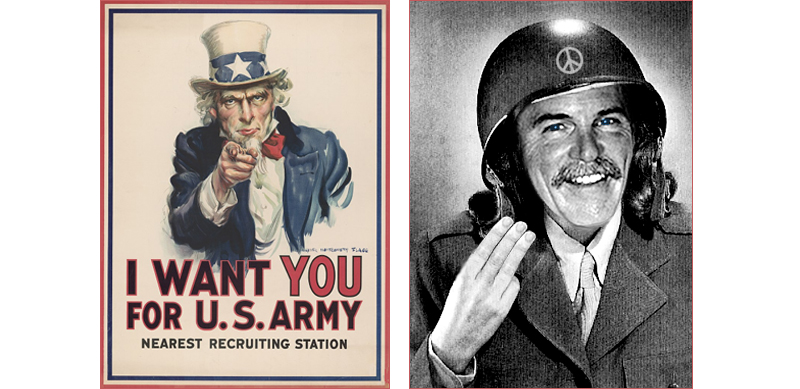
Fast forward to the 1950s: I was too young to serve in the Korean War, which ended in 1953. Then came the Berlin Crisis in 1961, a standoff between the U.S. and the Soviet Union. By then, I had already registered for the draft and anticipated being called to serve soon. Thankfully, the crisis was resolved when Khrushchev and Kennedy agreed to withdraw and reduce tensions.
By 1967, two of my high school friends had been killed in the Vietnam conflict. I recall Danny enlisted in the Marines, was sent to Vietnam, got wounded, and sent home. While at home, he got married, went back to Vietnam, and was killed the day he got off the plane—and, oh, his wife was pregnant. What a waste…
I vividly remember being called in for my Army physical during that period. Having spent a few years surfing, I was definitely buffed up but realized I was facing the real possibility of being drafted, and I didn't want to go to war and kill people. My determination to avoid war was strong, and I visited my doctor, who provided me with a letter explaining that I had contracted polio as a child, which left me with some muscle weakness on the left side of my body. I approached my Army physical with a mix of trepidation and hope.
My anxiety peaked as I found myself in downtown L.A., about to take the army physical. I recall arriving and lining up outside with other young men at around 8:30 a.m. While waiting to be evaluated, I noticed a familiar face among the crowd: Kent Sherwood, an acquaintance I had met at Dave Sweet surfboards in Santa Monica. Kent had grown up in Hawaii and was known as a big wave surfer and beachboy. Kent shaped boards for Dave Sweet back then, and we became friends. We surfed together a bit, and I remember him telling me about a time when he wiped out on a massive wave in Hawaii, was thrown to the ocean floor, and hit some coral. As a result, he contracted coral toxicity and consequently had to have his spleen removed.
Back at the Army physical, we were ordered to follow the colored stripes on the floor into a room where we took a written test and later underwent a physical exam. They informed us that if we scored 80% or higher on the written test, we would be eligible to sign up for Officers Candidate School (OCS). Right, that's just what I wanted to do for the rest of my life—be in charge of people and order them to go kill people!
We were directed to another room and given exam booklets. A tough sergeant yelled at us.
"This is your written test. We will keep you here until you pass."
The questions were multiple choice at about the level of "What color is the blue sky?" I didn't cheat on the written test and declined to sign up for OCS, firmly believing that my doctor's letter regarding my polio would be sufficient to secure a 4-F classification—dream on!

For the physical exam, we were instructed to follow another colored arrow on the floor to a different room. We were told to strip down to our underwear and stand in line. We were given a paper bag for our clothes; about 25 nervous young men. Kent stood next to me, and I noticed a large scar on his abdomen from his spleen removal surgery. Indeed, that would earn him a 4-F classification, right?
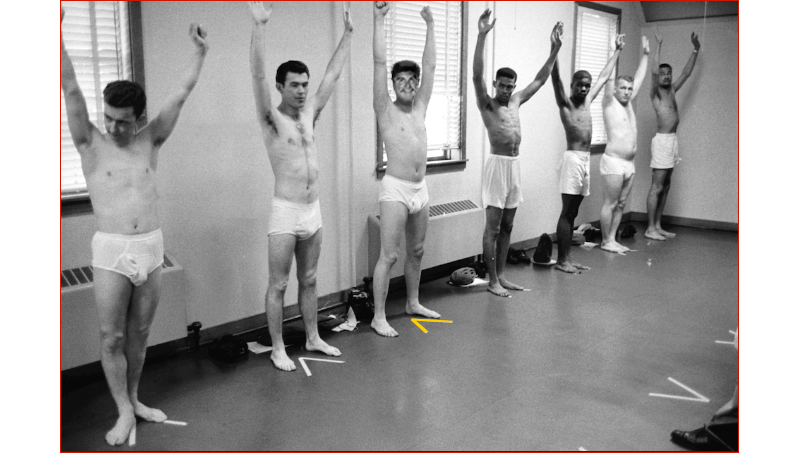
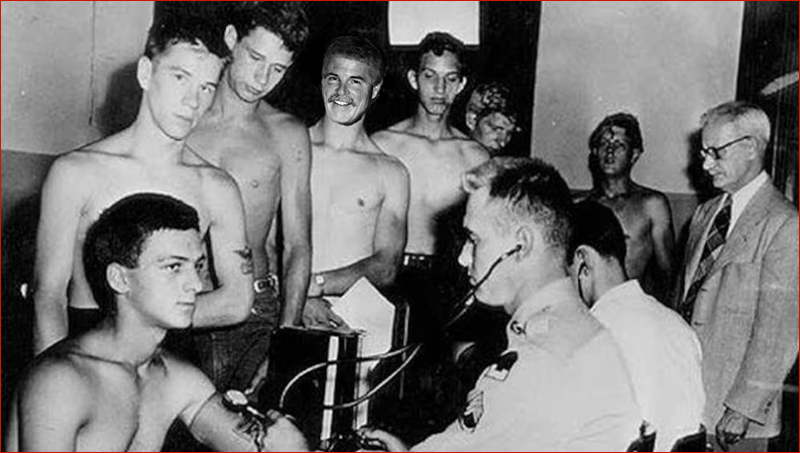
I clutched my doctor's letter as the Army doctors entered the room. They moved down the line, pulling down our drawers and shoving a finger up the right and left side of the scrotum while instructing us to "COUGH." So cough, I did, although it was a bit difficult when a complete stranger is messing with your boys!
Some of us had doctor's letters and were called into another room for further evaluation. There, a doctor sat at a table. He called us up one at a time.
He said to me, "What's your problem?"
I replied, "Well, sir, I had polio when I was 7 and have muscle atrophy on my left side."I showed him my left-hand muscle wasting and my doctor's letter.
He then pulled out a dynamometer and conducted a grip test to measure the strength of each hand. My right hand registered over 100 pounds, while my left hand measured around 55 pounds.
At that point, I was told I was dismissed, and I felt an immense sense of relief as I returned home to Santa Monica. However, I was still unsure of what had just transpired and what the future held. The uncertainty of my situation lingered, and I never found out what happened with Kent after our Army physicals, as we lost touch.
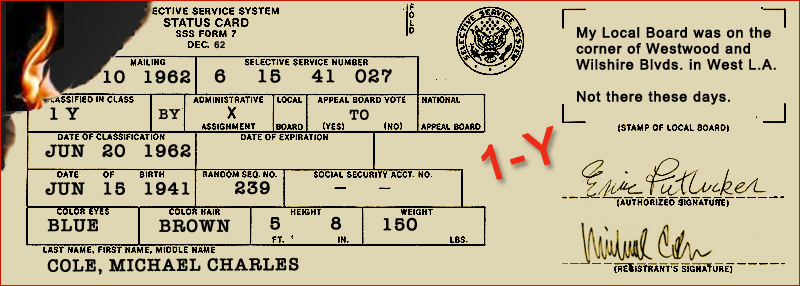
A few weeks later, I received a letter and card from The Selective Service stating that I had been given a 1-Y deferment, meaning I qualified for service only in times of war or national emergency—as if Vietnam wasn't considered a war or a national emergency. This classification eased some of my anxiety and allowed me to feel more confident in pursuing an art career. Ironically, the 1-Y classification was abolished in December 1971, and local boards were instructed to reclassify all 1-Y registrants.
I think about my friends back in the day and how they dealt with the draft. I consider myself fortunate that I was able to continue persuing my dreams.