
Stories: Not Too Far From The Ocean
The End of Polio? • I Was a Long-boarder • The Draft: What's Your Problem? • Timothy Leary? • To Ski or Not to Ski • Butch and Sundance • Dogs, Dogs, Dogs! • Arrivals • It's Just a Car • Fish On! • Music Musings • Walter Mitty Redux • Clamming and Crabbing • Grandpop: Can We Talk?
Music Friends:
Michael • Mark Perlman • Mark Jurey
Music Musings: Mark Jurey
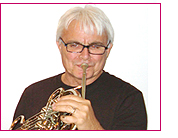 My Golden Age of Music
My dad, Ed Jurey, was the assistant music supervisor for the LA City schools, so I started playing his WW2 silver coronet as soon as I was strong enough to hold it. I am dyslexic; consequently, in the 1950s, a dyslexic kid was usually branded as a lazy troublemaker - my dad called me 'the snafu artist.' As a shy, dyslexic kid, playing music and designing stuff was the only way I could deal with life.
My musical salvation began in elementary school when I got to show up late to class every morning after playing "To The Colors" as the flag was raised. It continued in the Boy Scouts as the official bugler with a free ride to a national Jamboree. Then, free seats for the film "Spartacus" in Grauman's Chinese Theatre by playing "Taps" for the Veteran's Day premiere. Years later, I discovered that my future teacher was the lead horn player on the "Spartacus" soundtrack.
Thanks in part to my dad, LA led the nation in music education. Many of my schoolmates became leaders in the LA music scene. Arranger and sax prodigy Tom Scott (Steely Dan, Joni Mitchell, Blues Brothers) wrote me a solo intro to "Around Midnight" for his first band while at Grant HS. His father was a successful film / TV composer (Lassie, Twilight Zone, Dragnet). Jon Clarke (Loggins & Messina, studios, Academy Awards Orchestra) played oboe in my HS Orchestra. His brother, our first trombone, became the first chair double base with the LA Philharmonic. Marty Dicterow was my second horn in HS. His father was the first chair of the viola section of the LA Philharmonic, and his brother, Maurice Dicterow, ended up as concertmaster of the NY Philharmonic. Clarinet legend Jim Kanter (first-call Hollywood movie & TV for 30 years) led our CSUN woodwind quintet - we took first place in the free tuition competition every year. Playing with these guys fast-tracked my music education and provided the self-respect and confidence that I needed.
Below are three selections—Tom Scott, Jon Clarke, and Jim Kanter.
What Was I Thinking
I loved the French horn from the first time that I wandered behind a rehearsing orchestra. I started playing when my dad reluctantly agreed to buy me a horn in the 5th grade - only later did I appreciate his concern. The French horn is by far the most ancient, complex, and dyslexic of all instruments. It's fingered with the wrong hand, and sound comes out the back, interrupted by the right hand inside the bell - hey, sign me up. The difficulty lies in the close proximity of the notes, sometimes just 1/2 step apart, within the three-octave range, and sometimes in a single phrase, with quirky intonation, requiring a hand in the bell to adjust the pitch. But mostly, it's the 12+ feet of tiny tubing to be filled with sound from only 1/2" of the upper lip. Daily maintenance is required to keep the jaw and lip muscles strong yet flexible enough for the next performance.
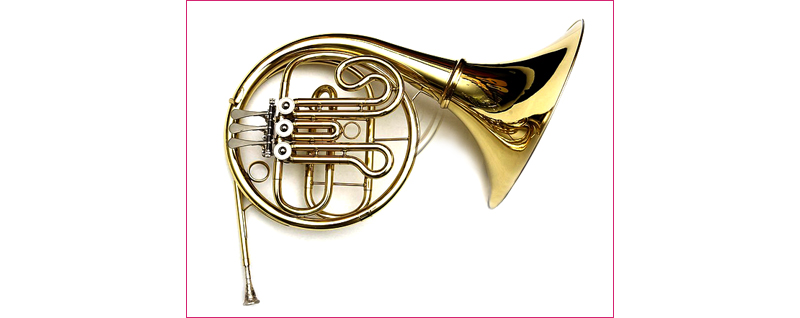
Due to the demanding physical requirements, the horn is the only orchestral instrument that requires an assistant first chair to share the load for major symphonic works. The assistant usually plays the loud or high parts, while the first chair saves the lip. Sometimes, the assistant holds a long note, allowing the first chair to let the blood return, or they split between upper and lower registers. Most classical lead horn players never make it past their 20's. At some point, the nightly stress, or the yips, or drugs, or booze, or one disastrous performance ends their career. I prepared for this for more than 18 years, and no…I don't miss tweaking my lip every day.
Continuing Education
Starting in high school, I was often called in to cover performances for college, church, and community groups. As a non-union anonymous sub, my pay was usually under the table, referred to as "gas money." I took weekly lessons all the way through High School. When I was preparing to graduate, my teacher asked me where I would be attending college. I told him San Fernando Valley State (now CSUN) to study industrial design.
He said, "Wanna scholarship?"…" Sure."
He reached for the phone, and it went like this:
"Clarence… Gene Sherry here, I think I've found your horn. Yes…yes…ok… I'll tell him."
And with that, I snagged the first horn in the orchestra, opera, wind ensemble, jazz band, and woodwind quintet for four years. Eventually, I had a state job as the photographer for the Music and Drama department, with my own custom darkroom located next to the music rehearsal hall. Reputation is everything.
During those college years, I was fortunate to have had so much enjoyment. One year, our Studio Band traveled to Miami and placed second in the National Jazz Band Competition. That summer, I played third horn for two weeks with the Portland Symphony in Jacksonville, Oregon - playing Handel's "Water Music" every night. The following summer, two weeks with San Kenton's Big Band at the University of Redlands and a five-week tour of Scandinavia, featuring "Beethoven's 5th" every night. I learned what it is to live the life of a musician.
Finding Success
As a college senior, I played my very first perfect performance - meaning that hundreds of perfect notes came together just as I had planned. After the performance, the audience and orchestra wandered off, and I was strangely depressed. This turned out to be my most crucial horn lesson… Only I could ever know what I had achieved. This was also a life-changing lesson for a young designer. Yes, we create for other people, but the real job is to satisfy our need for perfection. Only a few people actually appreciate what we do, and even fewer understand how difficult it is.
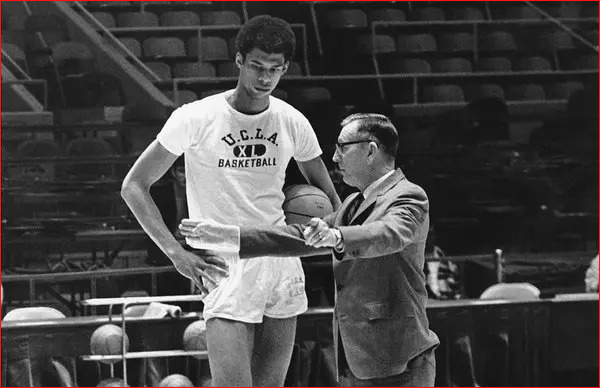
When my dad was a supervisor, his secretary's husband was Bill Barns, the football coach at UCLA. So when I was 13 years old, we had season tickets on the 50-yard line. Each game, just before kickoff, some guy sat down next to me, leaned over and said "hi"… I soon learned that it was John Wooden, the UCLA basketball coach. My dad and I both graduated from UCLA. One day, while crossing the quad, I noticed a guy sitting on a bench - his knees towered over his head. It was Lewis Alcindor (later Kareem Abdul-Jabbar) - our new center. He and his coach soon became basketball legions. Neither was concerned with fame, and John Wooden never even asked his players to win a game. His famous quote encapsulates everything I learned with my perfect performance. "Success is peace of mind, which is a direct result of self-satisfaction in knowing you did your best to become the best you are capable of becoming".
Red Light Time
My teacher, Gene Sherry (Star Trek, Bonanza, Little House, Dragnet, Beach Boys), also trained my ability to handle the inevitable pressure that comes with solo horn performance. If I aced a difficult passage, he would often say…
"Think you can do that with the red light on?"
In other words, when the the tape is running, the pressure is on, and a one-shot performance is required. I soon learned that the job is much like a field goal kicker - years of practice, days of preparation, hours of adrenaline, then seconds of pure terror - knowing that your next job is on the line. Because… reputation is everything.
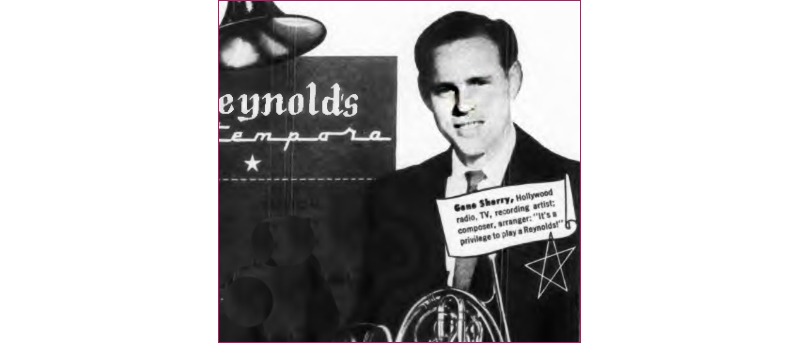
Below: A selection of Gene Sherry's film work.
Those years of pressure and experience taught me what I could not learn in school. The horn made me a better designer, a better teacher, and a better person and may have saved my life. Riding my BMW motorcycle in a freak snowstorm - flying my ultra-lite airplane when the propeller blows up - rock climbing in the Sierra as the cliff face begins to crumble - driving an ambulance at 100 mph as the patient in back bleeds out - arriving at my first university lecture to face 40 bored freshmen - I had learned how to practice, how to prepare my mind and reflexes. And how to access total concentration when a one-shot performance is required.
Going to War
In 1968, I bypassed 2,500 other young men and avoided the Vietnam draft by just a few weeks. I was accepted into the CA Air National Guard Band, whose members included LA classical, studio, jazz, and rock band heavyweights. I had played with many of these guys since high school, but I still needed to audition for those who didn't know me - literally, my first audition. Someone decided that I needed to play the theme from "How The West Was Won" by myself with full band accompaniment. This could have been a life-and-death audition before a room full of the world's best. As a result, I began receiving calls to do studio work when a non-union or unofficial backup was needed. This was when the anonymous Wrecking Crew (the go-to studio musicians for producers and artists, playing on recordings that ranged from pop and rock to surf music and more) was at work.
Hollywood Studios
One day, I received a call to appear at a recording studio on Sunset. I parked my TR3 in front, walked in, and was led to a big room with one chair, one stand, and one mike set low - they were ready for only me. I warmed up, put headphones on my left ear, and looked at the music. It was a classic eight-bar descant solo—a counter melody. I worked my weak left hand because it ended with a fast fingering sequence. The click track sounded in my ear; three guys looked out through the glass, one-pointed, and the red light came on. After 20 seconds, they looked at each other and smiled. The one with big hair handed me some cash and, as I walked out the door, called after me…
"Hey, who ARE you?"
I assumed he was impressed, but I now know that he was checking to make sure I was the Wrecking Crew guy who knew the code - don't ask, don't tell.
Over 50 years later, I heard that no rock horn parts existed, so I Googled "Rock Horn Solos." At the top of the list was The Rolling Stones "You Can't Always Get What You Want" and The Beach Boys "God Only Knows". My teacher, Gene Sherry, played the "God Only Knows" session. I listened to the Stones recording, and a flood of memories came back.
Don't Ask, Don't Tell
When I heard the "You Can't Always Get What You Want" solo for the first time, I knew immediately it was me. The lead-in features a jazz-influenced grace note to the upper "E" - a trick I used to make a jump-up sound like a slur. The center section, with my overly operatic phrasing, faded into what I assumed was the real melody. Yup, that's me. The connection to "God Only Knows" was too obvious to ignore. The same four notes were recorded two years apart in the same studio. Gene Sherry decided to glissando - his student chose to fake a slur. Both recordings become rock horn classics. I like to think that Gene would be proud.
Al Kooper played keyboard on the original recording - he was the guy with the big hair in my session. Later, the Stones sent him the tape and asked him to add 'horns' - meaning a sax section or brass. He said that Ray Alonge (Miles Davis, Dizzy Gillespie, Oliver Nelson, Quincy Jones), a renowned jazz horn player, had "coached" him in writing the charts. Ray was probably the second guy in the booth. When the album came out, Kooper said that the Stones gave him credit for the horn, but the 'horns' additions were scrapped, and only the French horn solo remained.
I have a lot of respect for Al Kooper. Even after fifty years, he has never directly claimed credit for writing or playing the solo, just as Ray Alonge and I have respected his appropriate need for recognition. Only the engineer—the third person in the booth—knows for sure who is on the final mix. I remember this as the beginning and end of my musical career. I had passed the red light test, but this was not how I wanted to spend my life. Time to move on and design some good shit.
Wet Dreams and Nightmares
I had many memorable experiences with some of the world's best young musicians of the 1960s as we tried to make a living, stay sane, and avoid the draft during the golden age of music. Some that still amaze me today.
Warming up at a Ventura Symphony concert to find that the seasoned's very first number began with an extended horn solo. Then, as they introduced big donors for half an hour, my lip turned to ice. Then, noticing the mikes and off-stage mixing board - we were live on the radio. At intermission, I needed to ask Jim Kanter how I had done. I was way too deep into the zone to remember anything.
At 19 Years old, on a five-week Scandinavian tour with the USC Isomata Orchestra, I looked back at the Oslo, Norway, high school girls' choir, trying to find one that I wouldn't love to take to an afterparty. Anika Ritmar chose me and took me to a cabin at the top of the ski mountain. She said I had Viking blood...!
Riding in a smoke-filled military bus, stuck in Dodger Stadium traffic, as our straight-guy trombone driver got a contact high and opened the door. He put the bus in first gear, got out, and walked alongside the moving vehicle, smiling and waving as he directed traffic.
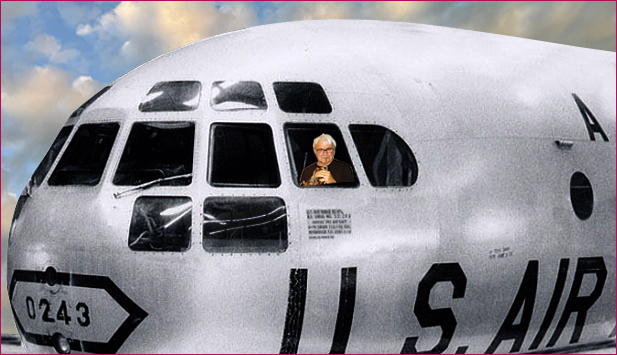
Flying to San Diego for a military parade in a C-97 Stratofreighter cargo plane. After strafing the sailboats heading to Catalina, we headed south, and the pilot came back to ask if anyone wanted to fly the aircraft. Straight-guy trombone pilot headed to the cockpit. I went up to check the wall of gages monitoring four ancient 28-cylinder radial engines - it did not look good. The engineering officer said…
"Don't you know, we only keep two good engines!"
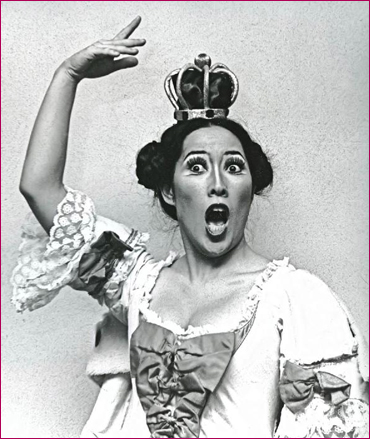
Walking to the pit for the last performance of Puccini's La Bohéme. Our 'Mimi,' Shigermi Matsumoto (later to sing with over 30 international opera companies), stopped me and said,
"Can you give me an "A."
My horn was in the case, so I fingered an "E" and sang her a concert "A." She thanked me and continued warming up down the hall. We had many unison parts together, and I think that she was letting me know how much she trusted my lead. And… that's when I discovered that I had "perfect horn pitch."
In rehearsal, playing the infamous tuba range solo in Mussorgsky's "Pictures at an Exhibition" when the professor stopped the orchestra and berated me for trying to ruin their months of hard work with my lack of preparation. The day before, I had flown in from Miami, where our Jazz Studio Band had come in second in the national competition. After the rehearsal, I told him that I was an art major, didn't need this shit, and he needed to find someone else to play that part. That weekend, during the big performance, he gave me a look… I raised my horn and baled the fuck out. I had unwittingly become a victim in the battle between jazz and classical music theology—a valuable early introduction to academia.
Parking my rusted Triumph TR3 at the starting area for a Memorial Day parade and seeing bandmates arrive in a BMW 2002, a Jaguar XKE, a full race prep Porsche 911, a TR 250, a beautiful three-cylinder Saab, and a Mercedes 280S. Obviously, some of these guys had a delicious taste and were making real money in the studios or on the road.
Standing at the urinal during a Valley Symphony intermission and hearing the guy next to me say,
"How's it going buddy?"
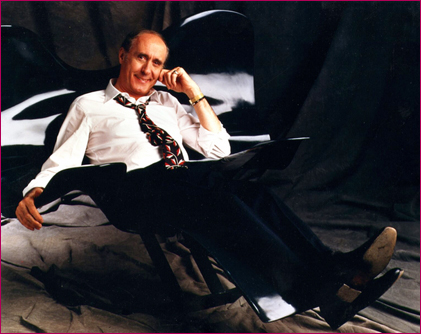
I looked over to see our guest conductor, Henry Mancini (four Academy and twenty Grammy awards)… smiling at me. It was going fine until then!
Talking to a failing student after my introductory design class. When he told me that he was our CSUN field goal kicker, I immediately noticed the tension in his eyes. I told him that he should be doing fine; he was the artist of the team - the only member who was free to be creative - as long as he found a way to split the goalposts.
Next week, he handed me the Sundial - our school paper. His photo covered the front page. He had broken multiple records - most field goals in a game, longest field goal, and most points, among others. A year later, he stopped by to tell me he was trying out for the Raiders in the morning. He went on to found a company that designed specialized equipment just for kickers - for example, that tripod that you see in every college and NFL game.
Sitting in the pit as the Beverly Hills Ballet performed on stage - thumping, grunting, gasping, and spraying sweat on my head. I never appreciated how physical ballet is, just as they probably didn't realize that I was drenched in sweat by the end of each performance.
Playing at the annual Hollywood Bowl "1812 Overture" concert with two-cannon accompaniment and watching the LA Philharmonic and Zubin Mehta disappear behind gunpowder smoke as drywall sifted down on my head. After six years of military service, this was as close as I got to a Purple Heart.
Playing With Myself
While in college, many musicians commented on my performance, saying,
"I have heard only one other person that plays like you… Marni Johnson."
Years later, I arrived at a new season of the Valley Symphony under Elmer Bernstein (Ten Commandments, To Kill a Mockingbird, Magnificent Seven, Great Escape, Ghostbusters). I showed up to play assistant first, only to find a new female first horn—a very unusual occurrence at the time. She said her name was Marni.
I said, "I've heard of you."
She said, "I've heard of you."
After the first rehearsal, we were so spooked that not a word was spoken for weeks.
Hearing Marni play was like hearing my voice for the first time. She was doing everything I hoped to do - probably better. It turned out that both of our teachers were students of famous horn educator Max Pottag. The technique, attitude, and aesthetic values were handed down through his two students to Marni and me. Our third-generation performances brought this magic back together for us in ways that were way too intimate to put into words. Marni Johnson continued as an LA freelance musician and teacher for over 30 years - passing on the gift.
Me and Mahler 1
I got a call to play a single performance of Mahler's Symphony No.1 with the Debut Orchestra (now USC Thornton Debut Orchestra). The Debut was composed of LA's most talented young musicians - many preparing to audition for orchestras around the world. Mehli Mehta, LA Philharmonic conductor Zubin Mehta's father, was the conductor. This symphony is scored for three extra horns, so there I was again - feeling like Forrest Gump and covering the lead horn of the extended section.
The Santa Monica Civic Auditorium holds 3,000, and it was packed with members of the classical music elite. Everyone knew that this was a once-in-a-lifetime event, so the performance was electric from the start. After almost an hour into the symphony, Mahler calls for the horn section to stand up for the big finale. When all eight horns finally let loose, the overtones were so thick that the notes seemed to suck themselves out of my horn. And… that was probably the most fun I've ever had with my right hand in a bell - or my clothes on.
After threatening to leave CSUN and teach at Cal Polly, I finally got a tenure track position and was required to meet with the Dean of the Arts, a member of the Music faculty. One of the first things he said was,
"So, you're a horn player, do you like Mahler?"… "Yes."
"Really?"… "Yes."
"Why?"… "How can you be a horn player and not like Mahler?"
When I left the interrogation, I wondered why he asked about music, let alone about Mahler. Then… I realized that he probably wanted to confirm that it was me he saw at that epic Debut performance. Years later, I took Debra to a Chicago Symphony performance of Mahler's Symphony #1. It was a chance to hear George Solti conduct and to let my future wife hear a legendary horn section in action… We were just taking our seats when I heard my name. I turned to see a CSUN faculty composer sitting right behind me. He was my nemesis - for several years, one of the significant obstacles to funding our tiny art department.He said, "What are YOU doing here?"…
I said, "How can you be a horn player and miss this?"…
After that evening, he treated me with the respect of a fellow musician - reputation is everything. He soon became Dean of the Arts, but the trust continued. I even covered HIS lead a few times - always anonymously. My dad never heard me play Mahler; in fact, he never heard me play anything after I graduated junior high school. To him, I could never be a real musician. When he died, I cleaned out his study. Sitting on the piano was a full orchestral score - all marked up in blue pencil. He had spent the last days of his life as if preparing to conduct... It was Gustav Mahler's - Symphony No.1 in D major.
PTSD
When I finally decided to quit playing, what I missed most was the experience of sitting inside a group - feeling the overtones mix - and creating a new reality together - the ultimate team sport. The multi-sensory aspects of horn playing are so all-encompassing that I never really heard myself play; I only felt the texture of each note inside my body. When Marni played, I went into a trance of ecstasy, and more than once…tears flowed…and I forgot to play my part.
Below a selection from Elmer Berstein's, To Kill a Mockingbird featuring Marni Johnson.
Listening is an entirely different experience that I had to learn to enjoy after I quit performing. Often, while sitting in a film or driving with the radio, I'll hear a unique tone or phrase and immediately recognize the genius of Jim Kanter or Tom Scott. It only takes a few notes, and I'm back to those golden years. Since I performed much of the classical repertoire, I usually find myself fingering the horn part. I often start deep breathing, experience an adrenaline rush, and feel my diaphragm tighten as a challenging horn passage approaches. Once a horn player, always a horn player - Semper Fi.
